Showing posts with label crops. Show all posts

Friday, July 2, 2021

An early July farm update

Hey, folks! The calendar has turned from June to July, the humidity seems to ratchet up by the day, and we are in full-blown "Summertime Mode" on the farm. Let me take a moment to share with you where we stand on our dairy herd and forage crops.

We currently have 160 cows in our milking herd after drying off 14 cows at the beginning of this week. We should hold there for a couple of weeks before we dry off any more, and then we'll start freshening a few toward the end of the month. I haven't checked the weekly "dry offs vs calvings" projections to see where we'll bottom out numbers-wise, but I would image around 135 sometime between late August and mid-September. But speaking of bottoming out, milk production has really started its annual summer slide. We could be getting a little more out of the cows, but when you take the high cost of feed and relatively low price for milk into account we're economically better off not pushing them to their highest production potential right now.

On the forage side, we have planted all of our acreage save for our bottomland which is still too wet to do anything with. Silage corn went into the ground a good month later than I had hoped for on account of wet conditions in late April through May, but we got it in and up and fertilized and sprayed. I've spent the past week drilling 100 acres worth of sorghum-sudangrass (sudex), the first of which has already started to emerge. If all goes as planned, we'll cut and chop it all before we begin chopping corn and then harvest it a second time as hay or baleage (and may graze some of it). We aren't planning to hay quite as much bermudagrass this year, but we are in-between the first and second full cutting on our best hay fields. 

Well, it looks like my lunch break is about over and it's time to head back to the dairy. I'll leave y'all with a few recent photos I've taken around the farm. Have a good'un!

drone shot taken from the southwest corner of the farm

drone shot taken at sunset after a rain (dairy barn on right)

good ol' Ms Nosey is still hanging around

our sorghum-sudangrass has started to emerge and will be a key part of our forage program this year


Saturday, June 29, 2019

Photos of the Week

Here are a few photos I snapped over the past few days that can help tell the story of what's been happening on the farm.


Monday morning we "worked" a group of 65 Holstein heifers and Angus-crossed calves. We ear tagged those that didn't yet have one and gave them their vaccination booster shots before moving them to a new pasture.


I didn't go looking for a beautiful sunset on Monday evening, but I found one while my son and I were trying to get a couple of loose steers back into their pasture. The milking herd gathered along the east side of their pasture to check out all the commotion and provided us with this photo opportunity.

Saturday, July 7, 2018

Farm Update - July 7, 2018

Hey, folks! It's been a few months since I've given y'all a farm update, so I figured I'd take a few minutes to get you caught up while I'm waiting on my post-milking coffee to finish brewing.

We're in the midst of another hot, humid Alabama summer. Thankfully, though, we've only had one or two "dry spells" over the last couple of months. Timely rains have kept our corn and hay fields green and growing, and it's looking like we might finish the season with a pretty good crop of each. Our first cutting of hay wasn't that great, but we'll be harvesting for the second time next week or as soon as the forecast says we can string together three days with low rain chances. The second cutting is usually our best, and we could also get a strong third cutting (and a fair fourth) if everything "hits" right. Our earliest planted corn will be ready to chop in 2-3 weeks, and so far it's passing the eyeball test. I won't be sure how the yield and quality compares to last year until we have it in the bunker, but I am optimistic it will turn out pretty good.

Cows heading from the milking barn to their feed trough around sunrise.
On the cow front, we currently have 170 coming through the barn each day. We've been drying off pregnant cows fairly regularly over the last six weeks, and we still have a good many more to send out over the next few months. We will have a handful calve toward the end of the month, and then it will start picking up steadily around mid-August. Milk production is down as it always is this time of year, and likely won't start ticking up until September.

Our long-term prospects for staying in dairy still aren't very good. The price we are paid for our milk has inched up a little bit but we're not expecting any kind of big bump in the foreseeable future. And regardless of price, our regional infrastructure is deteriorating at such a rate it just doesn't seem like staying in is a smart/safe course of action. That said, we are hopeful we can continue on for a couple more years and "milk" as much out of the next positive price cycle as possible. Ultimately, though, it looks like a transition away from dairy will be the most sustainable thing for our family farm. 

With that in mind, please keep us and our fellow dairy farm families in your thoughts and prayers in the coming weeks and months. Times are tough, and we're all facing difficult decisions over our farms' futures. While we are hopeful that we can make a strategic farm transition on our own timetable, many are finding themselves with no option but to sell their cows and equipment as soon as possible. It's a sad state of affairs, but we each have to play the cards we've been dealt.

To close this out on a more upbeat note, I want to take just a moment to brag on my son. We told our two farmhands to take a three-day holiday this past week, and LG was really helpful lending a hand in their absence. He's still about a year away from being a full-fledged milk hand, but he can do enough to make a noticeable difference when there's only one adult in the parlor. I'm hopeful that I can provide enough farm work (dairy or otherwise) in the coming years for him and my daughter to earn a few dollars and...more importantly...establish a strong work ethic that will serve them well in whatever career they ultimately choose for themselves.

Thanks for taking a few minutes to read, and have a "dairy" good day!

Friday, November 22, 2013

The Last 3 Weeks in Farm Pictures

A lot has happened around the farm the last three weeks, and I feel duty-bound to get you folks caught up to speed. Instead of a long written narrative, though, I'll let a few photos tell most of the story.

PUSH!!! PUSH!!! PUSH!!!
We have had A LOT of cows and heifers calve during November. A majority of their calves have been bulls, but that'll get turned around sooner or later.


Thanks to all the "fresh" cows, our milking herd has climbed up to 207 cows. This is the first time we've eclipsed the 200 mark in well over a year.


The switch back to Standard Time means we have the opportunity to see the first light of morning and sunrise every day before we finish the morning milking.


A larger milking herd (and those cows increasing their production) means that we're spending more time in the barn every day. My wife and kids have had to leave for school some mornings before I could get home for breakfast. But on the plus side, more cows = more milk = FULL MILK TANK!!!


Aside from the cows, I've planted quite a bit of wheat and ryegrass for them to graze next Spring...


...I've slung a little "Water 'n Poo" to help fertilize pastures...


...engaged in some Twitter nonsense...


...and we've generally been finishing both the field and milking chores just before sundown.


Though it's cold and lonely in the deep, dark night...I can see to plant my wheat by the GPS light.
(though I did run a little late planting wheat one night)


Despite the long, busy days on the farm, our family has still been able to find our way to Dear Old State for a couple of ballgames.


And the sun comes up again each morning, bringing with it new challenges, new opportunities, and a renewed sense of appreciation for the wonderful life I've been blessed with.

Wednesday, October 30, 2013

2013 Silage Harvest: DONE

Our 2013 fall silage harvest is officially complete! We chopped roughly 1970 tons of corn and sorghum silage over 66 calendar days, filling all three of our pits to capacity in the process. It was the best yield we've had in years, and it's good cow food according to the first forage test results we've received. It wasn't all easy, of course, and if you're a regular reader you know we've had mechanical, weather, and "we need to do extra herd work today" delays throughout. But it's done now...chopped, hauled, packed, covered, sealed, and ensiling. All that's really left to do is clean the silage chopper, take the side frames off of the dump truck, and watch our cows convert the silage into wholesome milk.

We'll celebrate this accomplishment by having a full work schedule through the end of the week, tend to our regular milking/feeding chores over the weekend, and then start drilling next Spring's wheat and ryegrass crops into the ground come next week.

we are now feeding our cows corn silage from the first pit we filled.


Friday, October 18, 2013

2013 Silage Harvest: Weeks 7 & 8 Recap

We weren't able to get but five days of harvesting in the last couple of weeks, but we made pretty good progress the days we were in the field. We finished chopping all of the forage sorghum across the road from our dairy, with the final estimated yield on the BMR 108 Leafy variety working out to 14 tons per acre (72% moisture). And though we got stuck a few times, we did get most of the sorghum in our bottomland chopped. It didn't yield out as well, which is a result of simply too much moisture the first 6 weeks after planting. 

We still have 18 acres of sorghum growing on hill ground to harvest, and we'll plan on knocking it out on Monday and Tuesday. We'll go back to the creek bottom after that to chop what we can of the roughly 10 acres worth of sorghum (spread over 59 acres) that remains. By the end of harvest, we will be going into the winter with the most silage we've had in years...actually more than last summer's and this spring's crop combined.

I will certainly be ready to celebrate the end of the long harvest season once we do finish, but that celebration won't last very long as we'll immediately start planting our spring grazing and silage crops. No rest for the weary, I guess, but such is life on a dairy farm!

Chopping sorghum in the Yellow Creek Bottom.

Looking out across a bottomland field.


Friday, October 4, 2013

2013 Silage Harvest: Week 6 Recap

Another week of silage harvest is in the books, and a few more tons are in the pit. Wet, soft ground early in the week and equipment trouble on Wednesday limited us to only 12 hours of actual chopping time, but we were fairly efficient when we were running.

Whoops! #nobueno
I guess the big news of the week happened Wednesday afternoon. With 3/4 of a load on my silage wagon, I attempted to pull my equipment downhill across a field terrace in order to start chopping a new pair of rows. I've executed this maneuver many times without incident, but not this time. I tried crossing the steep terrace at too flat of an angle with an unbalanced load in my wagon, and THUD!...the wagon and its 3.5 ton load tipped over and fell to the ground. It survived the fall relatively well, though, and we were back up and running Thursday morning.

About the only other news worthy of reporting is to mention that we did pull out of our hill ground on Friday morning to harvest some of the sorghum in our creek bottom fields. With the ground down there still a little soft from Monday's rain and more rain expected for this Sunday, we decided it would be worth our time to move even if we could only get a handful of acres. I harvested most of a 5.5 acre field (only got stuck twice), and then sent three loads out of another before we shut down for the day. I'll chop another couple of loads Saturday morning to use in our cows' feed ration this weekend, and then we'll probably pull the equipment back out Monday. The chopper has a few bearings and sprockets that need to be replaced, and we can probably knock out all of the remaining sorghum in our "hill ground" while waiting for the bottomland to dry more.

We still have a long way to go before we finish the harvest, but we're getting closer all the time.

The wagon has a side that's bowed out and is now topless,
but she can still get the job done after her fall.

Monday, September 30, 2013

2013 Silage Harvest: Week 5 Recap

Last week's harvest yielded several tons of sorghum silage per acre, but there's not a whole lot else worth mentioning (maybe that's a good thing). We got a good day in Monday, skipped Tuesday, had another full day of harvesting on Wednesday, and then finished filling our second pit up on Thursday afternoon. We covered and sealed that pit Friday morning, and since then we've only chopped enough sorghum to feed our cows each day.

Ten more "full" days of chopping should see us finish our harvest, but those ten days could easily be spread over three weeks. We had intended on moving into our bottomland this morning, but over an inch of rain quickly washed that thought way. Most likely we'll chop next to the dairy for the next two days and move to the creek bottom on Thursday...IF it doesn't rain anymore.

chopping sorghum on a cloudy morning


Saturday, September 21, 2013

2013 Silage Harvest: Week 4 Recap

Our silage harvest continued on this week, chopping two rows of sorghum at a time at the slow but steady pace of two acres an hour. By the end of the week, three more fields had been harvested and our cows have roughly 180 more tons of feed ready to ensile. Most of our BMR-90 sorghum variety is now "in the pit", with just over an acre's worth left still standing in a field where we planted one row of that variety along with three of BMR-108 Leafy. The yield per acre wasn't quite as good this week, mostly attributable to drier conditions at planting. Dry weather and another week of maturity also impacted plant moisture at harvest, dropping the sorghum from 68-70% moisture down to 62-65%.

Even though we had a good run this week, we weren't immune from breakdowns and maintenance downtime. Our silage wagon needed a couple hours of welding done to it Tuesday morning to patch up cracks in its frame and bed, and a snapped driveline on the chopper cost a half a day's worth of chopping. We also had to start using a different tractor to pull and power the chopper on Friday as our JD7810 needs a new internal bearing around its PTO stub. We hope to have that tractor fixed and back in the field by the end of next week.

Here are a couple of photos from this week's action:


looking back at the dairy over a field of BMR-90 forage sorghum


chopping the first few rows of our BMR-108 Leafy forage sorghum


Saturday, September 14, 2013

2013 Silage Harvest: Week 3 Recap

Much like last week, our silage chopper was in the farm shop more than the field during the first part of the week. We anticipated being down for a day to replace a set of bearings, but we found other parts that needed replacing as well. It was Wednesday morning before we finally had the new parts in and the chopper all put back together. Since then we've chopped 18 of our 50 acres of BMR-90 forage sorghum, which is yielding an estimated 7-8 tons per acre. Barring any more major maintenance issues [knocking on every piece of wood I can find] we should finish chopping this particular variety next week. We will then move on to our final silage crop of the year: 100 acres BMR-108 Leafy forage sorghum.

Here are a few photos from this week's harvest:


a half-harvested sorghum field

our BMR-90 forage sorghum is averaging 7-8 tons/acre

the BMR-108 Leafy variety is about a food shorter than the 90 but much more, well, leafy


Saturday, September 7, 2013

2013 Silage Harvest: Week 2 Recap

Downtime for repairs/maintenance and a few herd-related issues limited our harvesting time this week, but I did manage to finish chopping all of our corn by the end of it. The yields weren't quite as good this week, but we still averaged a very-good-by-our-standards 11 tons of corn silage per acre on our terraced fields. The smaller of our two main silage bunkers is nearly full, needing only a few loads of sorghum to "cap it off". Speaking of sorghum, I chopped about two acres of our short-season BMR following the last of the corn. It's too soon to get a handle on how it will yield out, but we should have a pretty good idea by the middle of the coming week.

view from the front window of my "mobile office" during silage harvest

Monday, August 19, 2013

Summer Break is over

For the first time since late May, my wife and kids were up and ready to go before I made it back home from the morning milking. Yes, today is first day of the new school year.  Summer break is over, and, coincidentally (or not), so is my hiatus from this blog.

another cloudy, damp August morning
The story over the last 10-12 weeks has definitely been the weather. Other than a dry stretch during the second half of June, we've had more than adequate amounts of rainfall and the summer heat hasn't been nearly oppressive as normal. In fact, I dare say we've had a few days of very "comfortable" weather this summer. Though late getting it planted, our silage crops look to have taken advantage of the extra water, and our first cutting of bermudagrass hay was outstanding. The second cutting is currently on the ground, but yesterday's drizzle and this morning's clouds will likely either delay or postpone the baler going into the field.

Well, it's 7:30 and time to get back to work. You can follow me on Twitter (@gilmerdairy) for a "play-by-play" of the work day, and I'll occasionally post a photo or short farm video there, too. So until next time, y'all have a "dairy' good day!

Tuesday, October 30, 2012

Fall planting season has finally arrived


Embedded image permalink
no-till planting wheat into sorghum regrowth
We began planting wheat for our spring silage crop on Monday. All in all, we expect to no-till drill the seed into 90-100 acres. Half of that ground is cropland on which we grew our sorghum crop this summer. The sorghum has experienced a little over a foot worth of regrowth thanks to a warm October and late frost, but it shouldn't impede the wheat's germination or growth.  The rest of our acreage will be in hay fields, and to get a good crop establishment there we will have to delay planting until after a killing frost.

Unlike the wheat we are planting for silage, we will plant our grazing crop into a prepared seedbed for the first time in several years.  This will be a four-step process:
  • We will "shallow till" by breaking the top of the ground with a disk.
  • We will spread manure slurry to incorporate nutrients and organic matter.
  • We will use a section-harrow to fill-in/level rough spots and smooth the ground prior to planting.
  • Finally, we'll use our seed drill to plant wheat and ryegrass into the prepared ground. A homemade drag attached behind the drill will help cover the seed and finish smoothing the ground.
We'll be able to apply additional slurry once the wheat/ryegrass establishes well enough to stabilize the ground. There is a chance we can graze the herd on this land before the end of the year if we have a mild November, but we'll likely be looking at early spring before we get much benefit from it.

God bless, and y'all have a "dairy" good day!

Thursday, September 20, 2012

Chopping & Baling

Heavy rain earlier this week forced us to shut down our harvesting for a couple of days, but we're back in business on two fronts: sudex and bermudagrass.

We started harvesting the sudex (sorghum-sudangrass) on Monday morning, hitting the field just an hour before the rain started falling. Harvesting this tall, thin, and densely-planted crop requires it to be mowed with a hay conditioner before being run through the silage chopper (as we're doing) or hay baler. Timing wise, it's providing us with a transition crop between the June-planted forage sorghum we finished harvesting last week and the almost-ready-to-harvest sorghum we planted in July. We resumed chopping on Wednesday, and should finish with the sudex either Monday or Tuesday of next week before switching back to sorghum.

We're also in the hay fields this week. Early Friday afternoon of last week we started noticing an unusually high number of crows flying around. Upon further investigation, our worst fears were confirmed: army worms! We decided we wouldn't be able to spray quickly enough to avoid major damage, so my father and I cut four hay fields Friday night and Saturday morning. As expected, Monday's rain came before the hay could dry enough to bale, but we "fluffed" it to dry it out yesterday. Lots of sunshine and low humidity did the trick, and we're raking and baling half this evening and the other half tomorrow afternoon. 

If you'd like a couple of more details click "play" on our latest GDF MooTube Minute below. And just one quick little note about our cows, we're currently milking 163 after the latest round of calvings/dry-offs/culls. I'm gonna go roll up some hay bales now...y'all have a "dairy" good evening!


Friday, August 10, 2012

Rain makes the crops grow

Timely and adequate rainfall over the past few weeks really helped our silage crops, hay fields, and pastures, even while much of the country is still suffering through one of the worst droughts in many years. 

After a slow start, the corn and forage sorghum we planted late-May/early-June has really come along and isn't too far away from being ready to chop for silage.  With 65 acres worth of hay planned to harvest over the next six weeks, we're only 60 round bales away from matching all of last year's total. And even though it still has a long way to go, the forage sorghum and sudex we planted in mid-July is off to a good start and should prove to be a good crop if we can get "normal" weather conditions over the next 2-3 months.

our forage sorghum is averaging between 6'-7' in height and is beginning to  head

we have a good stand of silage corn, though we're expecting it to yield less tonnage than last year

Thursday, June 7, 2012

Happy Dairy Month!

It's June, which is of course celebrated as Dairy Month all across this great land of ours!  I hope each of you will celebrate daily with at least three servings of delicious, nutritious milk, cheese, or yogurt. Heck, throw some ice cream in there as well! I promise that if you'll celebrate Dairy Month with "3 Every Day" you'll likely want to keep celebrating year round. That would be awesome (for you and me)!!!

Things are busy, busy, busy here on the farm. We planted our silage corn a couple of weeks ago, and it looks really promising at this early stage. I'm in the process of planing our forage sorghum (which we'll also harvest for silage), and should have half of it planted by the end of the day. Apart from the planting, I've been giving the tractor a workout applying fertilizer and spraying weed killer in and around our various silage fields, hay fields, and pastures.

The downside of June is that it is one of our most expensive months. On one hand we have all the costs associated with growing and harvesting our animals' forages, and on the other we have the reality that milk production (and the price we receive for milk) is going down. This is nothing new, though, so we know how to plan for it.

Speaking of the drop in production, we're getting to the point where we'll be "drying off" pregnant cows nearly every week. Eight left the herd for a two month vacation on Tuesday, and three or four will be following next week. We're currently milking 176 cows, and I can see that number possibly dropping below 160 sometime this summer. Time will tell.

Before I slam one more cup of coffee and go crank up the tractor, I'll leave you with a few tidbits:
  • Listen for me and other Southeastern dairy farmers on your local radio stations this month as we share how we're "Dedicated to Dairy" during Dairy Month.
  • Speaking of radio, I might be doing a Dairy Month-related radio and/or television interview sometime next week. I'll be sure to let you know once as I get more info.
  • Don't forget to click over to our farm's Facebook Page and enter our Milk Mustache Contest. Time's running out, so don't delay!
  • Speaking of contests, so me a favor and vote for Mississippi State's Muscadine Ripple Ice Cream this week in Progressive Dairyman's 2012 Flavor Faceoff.
Thanks, and y'all have a "Dairy" good week!

Thursday, May 3, 2012

Ryegrass harvest


It's been a busy two weeks, but we're nearly finished with our ryegrass harvest for this year. Our yields have been comparable to last year, and we should have enough harvested to make it our milking herd's primary forage from June until possibly as late as early October. Up to this point we have cut and chopped just over 75 acres with 12-15 more to go. Depending on the weather, we may pass on chopping a few of those acres in favor of rolling a few bales of dry ryegrass hay.

We will follow our ryegrass with a BMR forage sorghum variety just as we did last year, but we won't be planting that crop for at least a month. Next up on our "farming" agenda is planting our silage corn, which we tried to do two weeks ago but got rained out. That was probably a blessing considering we've had barely a sprinkle since then. If all goes perfectly (which, of course, it never does) we'll have our corn planted by the end of next week, spend the next vaccinating heifers and doing some pasture maintenance, followed by our first cutting of bermudagrass hay.

Here are a few photos from our ryegrass harvest, followed by my latest MooTube Minute video update:

We mow the ryegrass with a hay conditioner, which leaves the cut grass in a windrow.

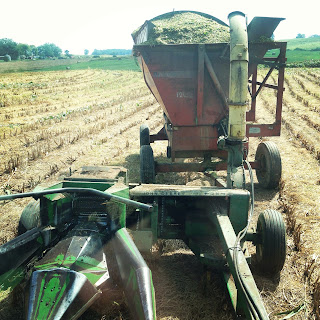
Our silage chopper (forage harvester) is a bit of a hybrid. The chopper itself is a John Deere,
but the forage head is a Gehl model my father modified to attach to the Deere.

Once the forage wagon is full, it dumps over into the truck.
The truck then hauls the ryegrass to the silage pit/bunker where it is packed.

Friday, September 23, 2011

Silage Harvest: the end is near

Silage chopping has run pretty smoothly this week, and I'm happy to report that we now have one silage pit full of sorghum. We'll take some time this morning to cover and seal the pit with plastic so the chopped sorghum will ferment properly. It will be several months before our cows eat any of this feed (we'll use up the corn silage first), but we expect it will preserve nicely.

We still have approximately 20 acres of sorghum remaining, which we'll chop next week and pack into our smallest silage pit. Once we're finished, harvesting 25 acres of sudex (sorghum-sudangrass) will be next on the to-do list. We might chop it and pack it into the pit as well, but we'll most likely make baleage out of it by cutting, baling, and wrapping.

For your viewing pleasure, I've included our latest MooTube Minute which focuses on our silage harvest. I hope you enjoy and, as always, have a "dairy" good day!


Wednesday, August 31, 2011

Smack-dab in the middle of harvest

Life hasn't slowed down on the farm since our hectic "hay day" a couple of weeks ago. In fact, it's done just the opposite. We've come to the point in the year when our nerves, our patience, and our equipment is pushed to the limit. That's right...we're smack-dab in the middle of harvest.

the silage chopper in action
We started chopping corn Monday afternoon of last week on a little 2.5 acre patch near the dairy. The "warm-up" allowed us to see what equipment adjustments were needed before we moved into the creek bottom and started chopping the rest of the corn on Tuesday. We didn't get much of a run on moving day thanks to a slow start and a braking issue with our dump truck, but we successfully chopped roughly 250 tons of silage over the next two days. We should have filled our first silage bunker up on Friday, but several mechanical issues derailed us before lunchtime. We resumed harvesting this Monday, and by late afternoon we had finally chopped enough silage to fill our first bunker. 

a full silage bunker or "pit"
Though there is still 9 acres of corn left to harvest, we are taking a few days off from chopping. We covered and sealed the full silage pit yesterday and cut 15 acres of sudex with the hay conditioner. We'll make baleage out of the sudex this afternoon (that is, we'll bale it at 50-60% moisture and seal each bale with plastic stretch wrap). Lessening the field work for a couple of days is also allowing us to move a few heifers and dry cows to different pastures. I expect we'll be back in the creek bottom tomorrow and should have the corn all chopped by midday on Friday.

"And he takes the tractor
another round..."
Moving forward, our tentative plan is to spend next week harvesting an additional 25 acres of sudex and applying slurry to several different hay fields. The week after that, we'll begin chopping our 90+ acres of forage sorghum. Where as the corn was planted in straight rows on flat ground, all of our sorghum fields are curvy and terraced. In other words, the sorghum harvest won't move along quite as quickly as the corn has.

With feed costs seemingly rising by the day, we're fortunate that we've harvested lots of quality forage for our cows thus far. If we can avoid any adverse weather over the next few weeks, we could be looking at one of the best harvest seasons we've had in quite some time.

Thursday, August 18, 2011

Hay Day

What happens when you mow down all of your hay with the hopes of baling it over two days? It either rains or you have equipment problems. Or both.

hay tedder
When we ended the day on Tuesday, we expected to start baling as soon as the dew was off mid-morning on Wednesday. By the time mid-morning rolled around, two light sprinkles had already fallen on our 65 acres of mowed hay and the clouds that remained weren't letting the sun shine through. As a result, I spent two hours using the tedder to "fluff" the hay so it would dry off more quickly. The sun finally broke through around 11am and the hay was ready to rake at 1:30pm.  

After two hours, I had 14 acres of hay raked into windrows.  I was only a few minutes shy of moving to another field when I was flagged down by our guy running the baler.

"A belt broke on the baler and another one is just about to."

Thus ended our plans of baling half our acreage Wednesday and half on Thursday.

windrowed hay ready to be baled
Wednesday's late start meant that we would not be able to get to the tractor place in time to get replacement belts before they closed for the day. Instead, my dad hit the road after milking this morning so he could be there when they opened. We expect to have the new belts on the baler by the time the dew dries off this morning, so hopefully we'll be baling by 10am.

When everything is working right, we can average about 20 round bales per hour. With 60 acres left to bale, we're looking at 8-12 hours in the field today depending on the yield, weather, and equipment. If we're REALLY lucky, the baler won't break down, the heat and humidity won't spawn a thunderstorm, and the evening dew won't fall until we have 200-250 bales of hay rolled up nice and tight. Whatever happens for good or for bad, this hay day is sure to be a long one!

UPDATE (12pm): 
Dad returned with the belts at 9am, and I started raking an hour later. Since we had a heavy dew, we decided to let the hay sit in windrows for about two hours before we put the baler in the field. I pulled up a RADAR image on my phone around 11, and promptly called my dad to say we needed to start baling immediately. As you can tell by the picture, there is a very good chance that we will be rained out this afternoon.

UPDATE (6:30pm):
The rain system started to fizzle out and went south of the farm, missing us completely. I don't know if it was due to meteorology or miracle, but either way I owe a moment of prayerful gratitude.

By 2:30pm the baler rolled up all the hay I had raked yesterday afternoon and this morning. We both moved over to our "big" field (26ac) near Mt. Pisgah Church and went to work. We've just finished with that field and are taking a short supper break before knocking out the remaining 15 acres about a quarter mile from the dairy. Barring any equipment issues, we should be finished between sundown and dew fall.

UPDATE (10:00pm):
I finished raking at 8:30, and just got word from my dad that he had finished baling. For the day, we rolled up 200 bales of bermudagrass hay (75 tons) off of 60 acres. We've yielded more tons/acre before, but the sacrifice in quantity should be made up for in quality.

Late this morning it sure looked as if we were going to be rained out, but the weather really worked out in our favor. Time will tell if we can keep that luck on our side next week when we (hopefully) begin chopping our corn for silage.