Showing posts with label agriculture. Show all posts

Monday, July 5, 2021

A hidden cost of rural broadband

Back in January '09, I was creeping down the information superhighway at 28.8kbps before "upgrading" to 1.5Mbps DSL in 2010. Over a decade later, in late April of this year, our local electric cooperative's Freedom Fiber broadband venture finally made it to our farm in all of its 100Mbps glory. And we could get up to a Gig if we needed it.

It is FANTASTIC!

Unfortunately though, we have discovered a hidden cost of having rural broadband on the farm.

Because our fiber network has been installed by our electric co-op, the lines are suspended beneath existing electrical lines rather than buried. That's not really a problem until they run too low across your fields.

A couple of tractors pulling hay equipment confirmed today what our eyes have been telling us for the past several weeks: there are two fiber lines crossing one of our hay fields that aren't high enough for all of our equipment to pass under. Thankfully, the equipment we had in the field today did just clear the lines, but we'll be out of luck if something doesn't change by the time Spring silage harvest rolls around.

these fiber internet lines are a few feet higher than my truck...but only a few inches higher than a tractor

The good thing about these lines belonging to our local electrical co-op rather than a big national company is that they'll work with you to solve the problem. I reached out to them this afternoon and have been told a crew will be coming to look at options within the next few days. Hopefully we can find a solution that doesn't involve having a pole sunk in the middle of the field, but we can deal with it if that's what it takes. Losing a few square yards of  hay or silage production around a utility pole is much better than losing a ten-foot swath the whole width of the field due to low hanging lines, and it's a price worth paying if that's what it takes to keep the broadband we've waited so long for.

UPDATE: The problem was fixed (without adding a pole!) less than 24 hours after I reported it. As I mentioned, that’s the benefit of doing business with a local company.

Friday, July 2, 2021

An early July farm update

Hey, folks! The calendar has turned from June to July, the humidity seems to ratchet up by the day, and we are in full-blown "Summertime Mode" on the farm. Let me take a moment to share with you where we stand on our dairy herd and forage crops.

We currently have 160 cows in our milking herd after drying off 14 cows at the beginning of this week. We should hold there for a couple of weeks before we dry off any more, and then we'll start freshening a few toward the end of the month. I haven't checked the weekly "dry offs vs calvings" projections to see where we'll bottom out numbers-wise, but I would image around 135 sometime between late August and mid-September. But speaking of bottoming out, milk production has really started its annual summer slide. We could be getting a little more out of the cows, but when you take the high cost of feed and relatively low price for milk into account we're economically better off not pushing them to their highest production potential right now.

On the forage side, we have planted all of our acreage save for our bottomland which is still too wet to do anything with. Silage corn went into the ground a good month later than I had hoped for on account of wet conditions in late April through May, but we got it in and up and fertilized and sprayed. I've spent the past week drilling 100 acres worth of sorghum-sudangrass (sudex), the first of which has already started to emerge. If all goes as planned, we'll cut and chop it all before we begin chopping corn and then harvest it a second time as hay or baleage (and may graze some of it). We aren't planning to hay quite as much bermudagrass this year, but we are in-between the first and second full cutting on our best hay fields. 

Well, it looks like my lunch break is about over and it's time to head back to the dairy. I'll leave y'all with a few recent photos I've taken around the farm. Have a good'un!
drone shot taken from the southwest corner of the farm

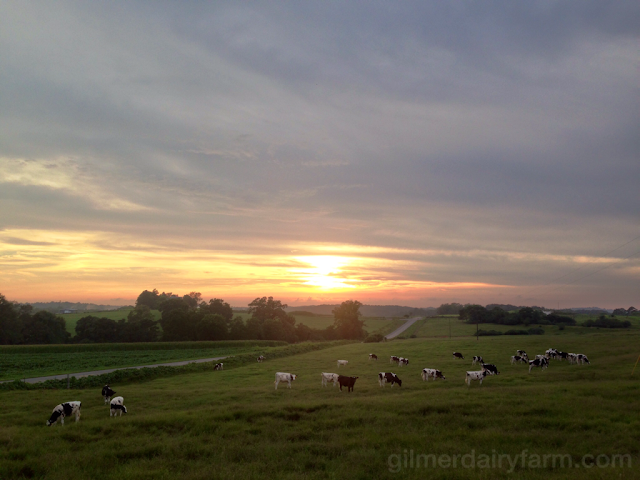
drone shot taken at sunset after a rain (dairy barn on right)

good ol' Ms Nosey is still hanging around

our sorghum-sudangrass has started to emerge and will be a key part of our forage program this year


Monday, June 17, 2019

Mid-June update

Well, folks, we've made it past the mid-point of June. And though we've been very busy on the farm these past few weeks, we still have a whole lot of work ahead of us.

This past week was a productive one...and unseasonably comfortable to boot! I sprayed and sidedressed our last remaining acreage of "hill ground" corn, and now all it needs is a few rains between now and harvest time. I was also able to drill roughly 40 acres of pearl millet seed into the ground which I hope to see pegging up by the end of this week. We also fertilized our hayfields, some with a commercial blend and a couple others with manure slurry. We have several pastures that need to be sprayed over the next couple of weeks, and our bottomland corn will likely need to be sprayed next week as well. We have a pretty good chance of rain every afternoon this week, and that will have a big impact on how much or how little tractor time I get over the next 7-10 days.

Our milking herd is still holding at 188 cows, though I figure we will dry off a few of the pregnant ones toward the end of the week. We opened up our final silage pit on Monday, and I'm not sure we won't run out before the first of this year's silage crop has been harvested and adequately ensiled. Reducing the number of cows in the milking herd along with their reduced summertime appetites will help extend our supply a bit, as will presumably our first cutting of millet. If we can make it through August off last year's crop, great! If not, we may have to buy and feed a "one shot" built-in-roughage ration for a couple of weeks.

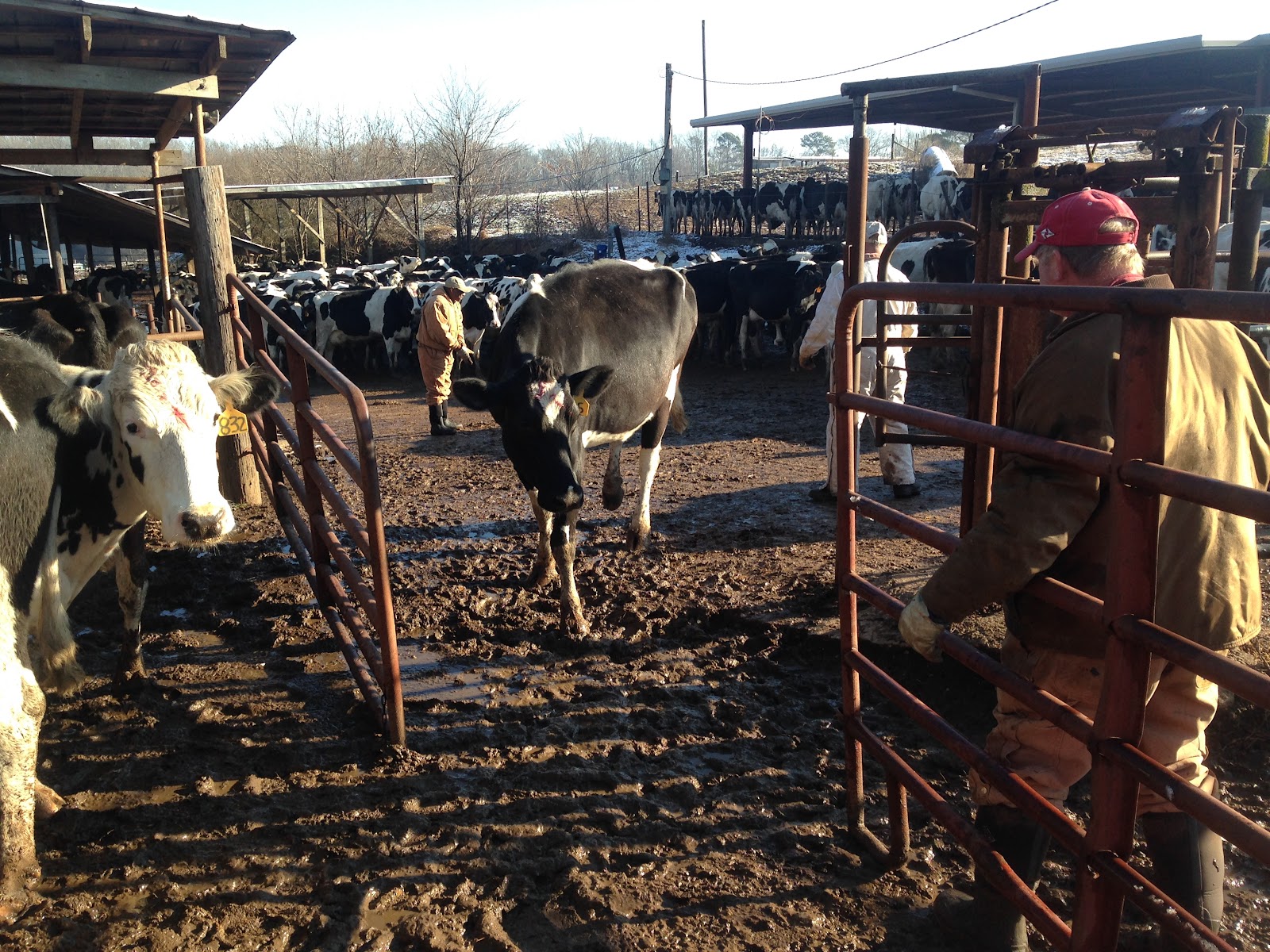
Depending on weather, we may start vaccinating our heifers and steers before the week's up. If not, we'll jump on that job early next week. I figure it will take at least three days to work through them, though we'll probably hold off on the oldest heifers until we can get a "preg check" lined up with our veterinarian. There is usually a lot of loose manure (and a few loose words) flying around the catch pen when we work heifers, but I'll try to keep my clothes...and my language...as clean as I can.

I'll leave y'all with last week's MooTube Minute. I hope you all have a dairy good week!


Thursday, May 16, 2019

Farm & Life Update (5/16/19)

originally posted Thursday morning at 6am

Good morning from the parlor where Dad and I have now milked 170 of our 193 cows and the sky’s changing hues herald the sun’s impending arrival. Fans have been circulating cooler fresh air through the barn to keep both us and the cows comfortable, a task that will be increasing difficult as we approach and soon enter the summer.

Despite two flat tires slowing progress yesterday and one of our farmhands needing off at least part of today, I think we are still on track to get our “hill ground” corn planted by the end of the week. If so and we stay relatively dry heading into next week, we could be looking at a run of days that are extremely busy even by dairy farm standards. There are hay fields to clip, bottomland fields to plant, corn to sidedress and spray, calves to vaccinate, and of course the cows still have to be milked twice daily.

On top of the farm work, I have a family to spend time with, Wednesday night Bible study lessons to prepare for June, cross-state meetings to attend, phone calls to make, and I’m sure a number of other responsibilities that aren’t immediately coming to mind. It can be overwhelming if I try to look too far beyond the horizon, so I just try to make the best of today and put myself in a good starting position for tomorrow. There is such a thing as being too busy, but Luke 12:48b says, "From everyone who has been given much, much will be required; and from the one who has been entrusted with much, even more will be expected." The Lord’s given me opportunities to be useful in different ways to different people and He’ll sustain me as long as I'm faithful to stick to the path He’s laid out for me.

So let’s all work diligently today but remember that our worth isn’t solely defined by our work. Take time to smell the roses, extend kindness to your neighbor, and have a dairy good day.


Tuesday, May 7, 2019

There's something about this place

Sometimes I catch myself staring at a particular spot in a field or pasture for no apparent reason. Occasionally I'll park a tractor in the middle of doing field work, climb up onto the hood, and spend a minute surveying the farm around me. I enjoy soaking up the beauty of my surroundings in the the quiet moments I often spend on my front porch after the morning milking or at the end of the day.

There's something about this place.

the view from my front porch this morning
I was told growing up that I was smart enough to go anywhere and do anything I wanted. But there's something about this place that made it impossible for me to believe I could ever be happy being anywhere else or doing anything else.

I've spent the last fifteen-plus years heavily involved in several different farming organizations, and that involvement has often required me to spend significant time off the farm. Perhaps the effort has not always yielded the intended results, but there's something about this place that drives me to use my abilities in a way that helps enable myself and others to farm more freely and successfully.

I've spent countless hours sharing the story of my farm and industry with classrooms, reporters, civic groups, and thousands upon thousands of people I'll never actually meet on the internet. It can be a grind at times, but there's something about this place that's worth telling people about...especially those who have no personal connection to such a place.

I wonder if my ancestors ever reflected on the past and pondered on the future of this little spot of ground like I do. I think about all the decisions that must have been made by my family members over the last century-and-a-half that have led to my opportunity to call this place home, as well as how many times a different decision along the way could have completely re-written my story before it ever started.

Our farm isn't blessed with especially fertile soil, and we fight more than our fair share of kudzu and privet and pigweed. But it's ours, and it's home. It's both where I live and make my living, and I pray that holds true until I draw my final breath. Perhaps our kids will choose to make their lives and rear their families on the farm, perhaps their dreams will carry them elsewhere. Only God knows what the future holds for this place, but we are thankful He's entrusted its stewardship to our family for multiple generations.

There's something about this place that makes it worth conserving.

There's something about this place that makes it worth fighting for.

There's something about this place that makes it the only place I'll ever be able to call "home."


Saturday, March 23, 2019

Springtime brings more milk and more work

Springtime is upon us and life on the farm is about to get much busier than it already is. It's been a few weeks since I've given y'all an update, so I figured I'd try to catch you up to speed before I start tackling some of the projects on this Saturday's "to do" list.

Fewer cows, more milk
Good ol' Ms. Nosey
Our milking herd topped out at 213 a couple of weeks ago, but we've since culled fifteen and are now sitting at 198. And while we have three more in the maternity pen that should calve within the next two weeks, we also have a half-dozen that are nearly ready to be "dried off." So, if we do cross the 200 cow threshold again it won't be for long.

Removing those lower producing cows automatically raised our herd's average daily production on a per cow basis by a couple of pounds right off the bat. Per cow production has continued to climb over the last couple of weeks thanks in part to better weather, and now our total production is exceeding what it was before we sold those fifteen cows. We'll "weigh" milk on Monday or Tuesday morning, and by the end of next week we should have updated production profiles for all of our milkers. That information will help us make decisions about whether or not we have any more cows ready to cull and which pregnant cows might need to be dried off earlier than two months before their due date.

Getting ready for field work
The days are getting a little longer, warmer, and drier, and I'm itching to be in the field. We still have a little ways to go before we'll be ready to break any of our corn silage ground, but with good luck and favorable forecast we may be able to have some bulk fertilizer spread within the next 10-12 days. We've been able to spread enough manure on the fields adjacent to the dairy to get by without needing any commercial P & K, this year, but we'll still need a blend spread over about 2/3 of our "hill ground" acreage. I haven't even pulled soil samples in our bottom land yet, and I figure it will be at least mid-May before it is dry enough to plant. If all goes as planned, though, we'll be looking at planting around 170 acres of silage before all is said and done.

Tuesday, July 10, 2018

Ten years later: the rest of the story

This morning I found myself in a reflective mood thinking back to mid-July 2008 and one of the most hectic weekends of my life. I blogged about it at the time and recommend you give it a quick look over before proceeding with this post. You can read my original account by following this link.

In the post I linked above, I made a short reference to a meeting I attended on that Saturday. Today, the only reason I remember anything about that weekend is centered on that meeting, why I was there, and how I got there and back without missing a milking shift.

And now, the rest of the story.

I was serving as the chairman of the Alabama Farmers Federation's Young Farmers Committee at the time. My committee's goal that year was to eliminate a couple of old contests and reallocate resources towards new contests and programs we thought would help attract and develop new YF members at the county level. Though we were convinced this was the right move for our program's future, we expected a lot of resistance. These contests, the Miss Alabama Agriculture Pageant and Talent Find, had provided entertainment at county and state annual meetings for years and were considered to be "sacred cows" by many of our members.

Getting our county YF chairmen on board with the proposed change wasn't difficult. Many of them were fed up with these old programs and ready to move in a different direction. The trick was going to be convincing the Federation's Board of Directors and County Presidents that this was in the best long-term interest of our whole organization, not just the Young Farmers program.

After briefing the Board at its June meeting, I was given the green light to address the County Presidents at their conference in July. The Board would weigh their input and then make a final decision later on in the year. The problem was I couldn't attend that July meeting. My father (then our county president) was already registered to attend, and our farm labor situation was such that we could not both be away from the dairy at the same time. Driving down and back in between milking shifts was out of the question since the conference was being held nearly 300 miles away in Point Clear.

About a week before the conference, our Young Farmers director and I began discussing how best to deliver my committee's proposal without me actually being there. I can't remember for sure, but I think we were settling on the idea of him clicking through a PowerPoint while I talked via teleconference. Toward the end of our conversation he asked if there was any way at all I could make the trip down to Point Clear and deliver the presentation in person. I jokingly replied, "Not unless your bosses will sign off on sending the company jet up here to shuttle me back and forth."

About an hour later my YF director called me back and told me his bosses had indeed signed off on it.

So that Saturday I met the plane in Hamilton after the morning milking and flew down to Point Clear (a 45-minute flight versus a five-hour drive). I presented my committee's recommendation and...to my great relief...received near unanimous support from the County Presidents. I was flown back to Hamilton and was milking cows by 1:30pm. The Board officially accepted our recommendation later that Fall and the final Miss Alabama Agriculture Pageant and Talent Find contests were held at our Annual Meeting in December.

In the ten years since, our organization has grown participation in Young Farmers events and developed a deep roster of strong future leaders. And while my committee's efforts in 2008 probably won't be remembered by anyone who wasn't directly involved, I like to think we played a part in paving the way for the good things that were to come. If nothing else, the experience helped prepare me for the leadership roles I've held since. And for that I'll always be grateful.

And now you know...the rest of the story.

Elected and ex-officio members of the 2008 State Young Farmers Committee


Wednesday, March 1, 2017

Hey folks, it's been a while

Hey folks, it's been a while. Let me catch you up to speed on what's been happening on Gilmer Dairy Farm recently.

We currently have 223 cows in our active milking herd, which looks like our "high water mark" for this year. We will be sending several cows to the stockyard over the next couple of weeks, and I anticipate a herd size of around 210 after the next round of dryoffs, calvings, and cullings. Our daily herd production topped out at roughly 13,750 pounds of milk a couple of weeks ago, but our average per cow should improve by two or three pounds in the coming days for a couple of reasons. First, simply removing a few lower producing cows will boost the average. Secondly, we expect to see a production increase when we begin incorporating corn silage into their ration once again.

We had an incredible drought this past year, one that lasted well into late Fall. As a result, our dryland (non-irrigated) corn crop yielded far below what was needed to feed the herd for a whole year. Over the last couple of months we have been relying on last Spring's bumper ryegrass baleage crop, dry hay, and cottonhulls in a ration that allowed us to conserve our corn silage. This ration has worked well for us and our herd, but the cows' milking potential isn't as high as it is when they are on a diet that includes quality silage. We're at the point now we believe we have enough corn silage to make it into the summer, so we will be transitioning the cows to a new ration over the next couple of weeks.

Speaking of crops, we hope to be putting a lot of seed in the ground during the month of March. We were unable to plant any ryegrass or small grains last Fall due to the drought, and it's about been too wet since the first of the year. We should get a few days of dry weather after today's batch of thunderstorms rolls through, and I hope to begin drilling about 50 acres of late Spring oats on Monday. Our goal for this crop will be to harvest it as baleage in late April or early May. In addition to the oats, I hope to begin planting our silage corn crop the last week of March. We're looking at roughly 110 acres on our "hill" ground this year, and another 40 in our bottomland.

On a personal note, it seems like there's always somewhere else I have to be. Don't get me wrong, because I really enjoy being involved in my industry! But speaking at a dairy conference in Savannah, two meetings in Montgomery, and judging a farm contest in Natchez over the last five weeks has made it pretty tough to "get in the groove" farming wise. And over the next two weeks my schedule includes speaking at an elementary school, SXSW in Austin, and my regional dairy checkoff's annual meeting at Stone Mountain. And on top of that I'm helping coach my son's baseball team which begins practice this weekend. So yeah, I have a full plate in front of me, but better to be busy than bored. Besides, if I have too much free time on my hands I might start seriously considering making good on my threat to run for office...

Thanks for reading, and y'all have a "dairy" good day!

Friday, August 22, 2014

Farm Photo Friday, 8/22/14

Happy Friday, y'all! I would like to talk a little bit about three photos I posted over the last few days on this week's edition of Farm Photo Friday.


If you were keeping up with me on Twitter or Instagram this past Sunday night, you know I had a long evening. Armyworms had once again invaded our hay fields and required extermination as soon as the afternoon milking was finished. I was expecting to spend several hours in the tractor cab, so I ran home to change clothes and grab a couple of sandwiches my wife had packed for me. Later in the evening and well after sundown, my wife pulled into the hay field I was spraying and hand-delivered this cup of her homemade Milky Way ice cream. She had made it for the ice cream social that was to be held at church that evening, and wanted to make sure I got some. So the purpose of this photo is to mention the fact we had more armyworm problems, but more so to recognize my wife as being totally awesome!


We have finally started seeing a lot of activity in our maternity pasture. I think we have had ten calves born this week, and that is just the tip of the iceberg of what's to come over the next couple of months. Despite all the fresh cows rejoining the milking herd, we are also drying off other cows at about the same rate. Our calvings vs dry offs should stay roughly equal for another couple of weeks, and then in September we will start to see our milking herd have a sustained increase.


We started harvesting our corn this week, and hope to have 25 acres chopped and packed into the silage pit by the end of the day. You can see in this picture that the bottom half of the corn is starting to brown, both a sign of its maturity and the result of hot, dry weather. Most of our fields are sloped and terraced, and we have a good number of "short rows" to contend with (look just right of the tractor). We've avoided any major breakdowns up to this point, but we have a long, long way to go before this harvest season is over.

Tuesday, August 19, 2014

Dairy Good Questions (8/19/14)

Welcome to the debut edition of "Dairy Good Questions", a new midweek feature in which I answer 2-3 questions people have asked about my farm or the dairy industry. Let's get right to it:


DGQ #1) "Will, do you have a favorite cow?" (via Whit Macknally)

Answer:  As a matter of fact, I do: Gilmer Dairy Farm cow number 859. She's big and tall, she's a good milker, she's as laid-back as a cow can be without being overly stubborn, and she never gives the first bit of trouble in the barn. She might not have strong idiosyncrasies like Ol' Number Seven had, but she does have her own spots where she prefers to stand in the barn and isn't shy about moving other cows out of "her" space. And unless she's on her way to eat, she always seems to appreciate a good head-rub. 


DGQ #2) "What's the milkfat/butterfat percentage of whole milk?" (via Josh Johnson)

Answer: Some of the milk in your local grocery store is identified specifically by the amount of butterfat it contains, such as 1% and 2% milk. Skim milk contains only traces of butterfat (< 0.5%) or none at all. Whole/Vitamin D milk, on the other hand, often doesn't give a clear indication of its butterfat percentage on the label. The federal minimum butterfat percentage standard for pasteurized whole milk is 3.25%, and most of it retails at or just slightly above this percentage. Exceptions include whole milk sold in California (3.5% minimum) and some brands of "cream line", or non-homogenized, milk. And while you might not find the actual butterfat percentage listed on a jug of whole milk, its nutrition label will include the grams of fat per serving along with information about protein, calcium, vitamins, etc. My advice is to drink whichever bf% milk you enjoy the most and adjust the rest of your diet accordingly, but do take time to compare labels and choose one that fits best within your overall nutritional plan. 

That's all for this week, but please let me know if you have a "dairy good question" you would like to have answered in the future. You can leave your questions via the comments section on this post, tweet them to me at @gilmerdairy, or post it to our Facebook page. Thanks for reading! 


Monday, May 19, 2014

Spring silage harvest has begun

After making a few "test runs" over the weekend, we are now full-bore into our spring silage harvest. As per normal operating procedure, we will cut our wheat and ryegrass with a hay conditioner and chop it with the forage harvester (silage chopper) a few hours later. We plan on harvesting roughly 75 acres over the next week and a half, weather and equipment permitting. Following the harvest, we will turn our attention to planting sorghum and harvesting our first cutting of bermudagrass hay.

Our silage wagon is still topless after my little accident last Fall.

A dump truck will transport the freshly cut forage
to the silage pit where it will be packed and sealed.

Thursday, April 24, 2014

FARMLAND to be screened in Birmingham on 5/1/14

Get ready, Birmingham-area residents! On May 1st, you will get the opportunity to shake the hand that squeezes the teats of cows that make the milk you drink! That's right, I will be in B'ham for a couple of hours that evening and would love to chit-chat with you for a little while. You don't want to pass up this golden opportunity, so go ahead and mark your calendar to come see me at the Regal Trussville Stadium 16 movie theater next Thursday night!

Georgia chicken farmer Leighton Cooley
with documentary crew (courtesy of farmlandfilm.com)
All kidding aside, I will be there in support of something I know you will enjoy. The main event is the public screening of award-winning director James Moll's new documentary Farmland, and the stars of the show are the six young farmers and ranchers who share their passion for agriculture and the challenges they face trying to make a living doing what they love. The film's subjects represent a wide-spectrum of American agriculture, from livestock and poultry to commodity crops to organic produce to community supported agriculture (CSA). I had the good fortune to see Farmland last month, and from a farmer's perspective I thought it was incredible! But even though this film is about people like me, it isn't really "for" people like me. This documentary was made to provide the non-farming public with an intimate glimpse at how our nation's food is raised on a daily basis.

I encourage all of my friends in and around Birmingham to buy a ticket for the "one night only" public screening at 7pm on May 1st. Based on past conversations I've had with many of you about my dairy farm and food production in general, I have no doubt that you would really find this film interesting. The Alabama Farmers Federation will have a table at the theater from 6:00-8:30pm, so come a little bit early. I and perhaps a few other local farmers will be on hand and would love to talk with you about how we grow and raise the food you and your family enjoy.

I look forward to meeting you, and I know you will genuinely enjoy Farmland. See you next Thursday night!

Saturday, April 19, 2014

Favorite farm photos of the week

Happy Saturday morning, folks! Over 2.5 inches of rainfall on Monday kept us from making any progress toward planting corn, but we found plenty enough to keep us busy. And through it all, I was able to snap and share a handful of farm photos. In case you missed them, here are a few of my favorites from the past week:

Palm Sunday sunrise

the milking herd beginning the second grazing rotation

Cow no.88 won't leave the road until she's had her head and neck rubbed.

A traffic alert/PSA letting people know how our cows' route to and from grazing
would affect their commute. I think we had to stop two cars over the course of three days.
Have a wonderful Easter, everyone!

Tuesday, April 15, 2014

In Memory of my "Daddy G", Gray Gilmer

Twenty years ago today my grandfather, Gray Gilmer, passed away at the age of 82. He was the youngest of his parents' nine children, was born and raised on the farm our family still calls home, and established the dairy my father and I operate today. A few years ago I wrote a blog entitled "My Farming Forefathers" which included a little bit about his life and my own childhood memories of him, and I hope you will take a few minutes to check that out. In addition, here are three passages my grandmother wrote about his early life in her memoirs, For Sentimental Reasons. 

Gray Gilmer, 1911-1994
On his name:
George Gray Gilmer was born October 10, 1911, on the farm that is still in the family's possession. He was named for his father, George Franklin Gilmer. Even though Papa Gilmer was the most respected man in Gray's life, he didn't like the name "George". In our courting days, he wouldn't even tell me his first name.
On childhood farm chores:
As a little boy, he and Annie Mae were assigned the job of shelling and feeding corn to the chickens and everything else that ate corn. The despised job was tending to the geese to keep them from getting more than their share. There was always an old gander that kept watch, and when Gray's back was turned, the old rascal would latch onto him with his strong beak and beat the daylights out of him with those powerful wings. He said he always carried some ammunition of corn cobs in his overall pockets in case he had a chance to defend himself before the attack. 
Summers were spent working in the fields of cotton and corn. He never minded the hard physical labor, but used to say what galled him the most was when Papa would insist on his helping their nearest neighbors "catch up" with the hoeing and chopping of cotton...He said he'd get his work done and then go help those slow and lazy boys while their father sat on the porch and instructed them as to how the job should be done. 
George Gray Gilmer, 10/10/1911 - 4/15/1994. Husband to Mary, Dad to Don, Marianne, Josephine, and David, "Daddy G" to Donald, Doug, Mark, Tommy, Leanna, Amy, Charlie, Will, and Lydia.


Saturday, April 12, 2014

Weekend Farm Update

Another busy week on the farm is coming to an end, and the next one could be even busier. But before I look ahead, let me quickly catch you up on what's been happening on and off the farm since I last blogged a couple of weeks ago:

National AgDay: As I mentioned in my last posting, I participated in a USFRA-sponsored panel discussion entitled "The Next Generation of America’s Farmers and Ranchers" during National AgDay in Washington, DC (recap/audio). I was afforded the opportunity the next evening to attend a special screening of Farmland, a documentary in which six young farmers/ranchers from across America talk about their passion for agriculture. I know documentaries aren't the genre most people watch when they go to a movie theater, but I strongly encourage you to see this one. And speaking of watching something, check out the MooTube Minute I filmed in front of the Capitol while I was in DC.

at the Farmland screening with film subjects Brad Bellah & Leighton Cooley on the left,
fellow USFRA panelists Kate Danner, Seth Pratt, & Joel Mathiowetz on the right

Lamar County Cattle Drives: Back on the farm, we've held pretty steady at 210 cows in milk. We're still grazing them every day, which sometimes requires what I call a Lamar County Cattle Drive. Almost all of the land we strip-graze our cows on in the Spring is across the road from our dairy barn and their primary pasture/feeding area. Most of the acreage is accessible to them by simply crossing the two lanes of County Road 36, but grazing the furthest paddocks requires a road trip. Several times we've walked our herd down 1500' of CR-36 and into their paddocks in the morning and then back to the dairy barn in the afternoon. We have only needed to stop a few cars during the cattle drives, and none of those drivers seemed to be too put-off by the five minute delay. I've posted several pictures and short videos on Instagram and my various other social media channels, so be sure to check those out if you haven't already.


Baseball: My family will soon begin claiming the Vernon City Park as our secondary residence. Both the kids are playing baseball this year, and I'm a volunteer assistant on my son's coach-pitch team. Having games or practices three nights of the week has cut into my "crash on the couch" time in the evenings, which has in turn really made me put a priority on taking naps during my breakfast and lunch breaks. And though I'm not getting as much rest as I need and our lawn and landscaping have become woefully neglected, we are all having fun with it. Now if only my son's team could get that elusive first win...
our little ball players

She's having a baby: Our local veterinarian was on the farm this past week to check 62 cows for pregnancies. It was a good result as 54 of the cows checked out positive, giving us a total of 127 pregnant milking cows. We still have quite a few to breed over the next few weeks, and need to do so before hot weather and heat stress wreak havoc on the conception rate.
Dr. Hidalgo preg-checking a group of cows

Looking ahead, we expect to plant silage corn in the very near future. Rain is in the forecast for Monday, but hopefully it will be dry enough to get in the field by mid-week. If so, we're targeting 40 acres of our "hill ground" to fertilize and plant by the end of the week.

Tuesday, March 25, 2014

Happy Ag Day!

I would like to take a moment to wish all of you a very happy National Ag Day! I'm celebrating the event in Washington, DC, where I will be part of a panel discussion entitled "The Next Generation of America’s Farmers and Ranchers" later this afternoon. This discussion is just one of several events associated with Ag Day in DC, and only one of hundreds being held this week around the country. I'm sure you can contact your local agricultural organizations to find out about events being held in your area.


Ag Day means different things to different people. For some, it's an opportunity to reflect on the contributions of great agriculural pioneers such as Dr. Norman Borlaug. For others, it's a chance to assess agriculture's current social and economic impact. Personally, the thing I most appreciate about Ag Day is that it provides an excellent opportunity for Americans to learn more about our nation's farms and the families that raise our food. This awareness can help build relationships between consumers and farmers and serve as the starting point for conversations about how our food is grown and raised.

So no matter what your connection is to agriculture, I hope you have the opportunity to attend an Ag Day event or at the least take a moment to reflect upon it's impact in your life. And as always, I certainly appreciate all of you who buy milk and dairy products...it's YOUR support that enables me to make my living doing what I love. 

Have a "dairy" good Ag Day!


Sunday, March 23, 2014

It's Grazing Time!

It's been a long, cold Winter, but Spring has finally sprung and that means that the grazing season is upon us! The wheat and ryegrass we planted late last Fall has gotten tall enough (and the ground firm enough) to begin grazing our milking cows in the mornings, which we've done now for four consecutive days. The girls have already responded by upping their milk production a couple of pounds, and I suspect that number to climb by a couple more pounds by mid-week.

As a reminder to my local readers, most of our cows' grazing land is across the road from our dairy barn. Be prepared to stop and watch the cows cross the road for a couple of minutes if you plan on driving by our farm around 8:30am or 1:00pm. 

Now, here are a few videos and photos from the first few days of grazing:


I love the sight of our black & white cows out in a green pasture!

Mooooving on down the road back to the milking barn.

cows on their way to graze

With their bellies now full of green grass, the cows are ready to head back to the milking barn.


Lamar County cattle drive

Thursday, March 6, 2014

5 years and 20,000 tweets later...

March of 2009 was a big month for me. It was the month I left my 20's behind and said hello to 30, embarked on my two-year AFBF Young Farmers & Ranchers Committee adventure, and welcomed my baby daughter into the world.

I also tweeted for the very first time:
I didn't have great expectations for Twitter at the time, or at least not my usage of it. The thought of sharing short bursts of farm info was intriguing, but I didn't think you folks would find my tweets as interesting or useful as my blog or my farm's Facebook page. Once I figured out that I could post real-time updates via text on my Razr v3 flip-phone, though, both my follower count and my own interest began to rise. I upgraded to a smartphone within a couple of months, and my new-found ability to interact with other Twitter users while in the milking barn or in a tractor cab encouraged me to tweet even more frequently. 

So now here I sit, five years and a little over 20k tweets later, and I wonder what kind of impact I've made. As I stated in my very first tweet, my goal was to let you know about life on my family's farm, and that still remains the primary focus of all I do online. There are other farmers that interact with and influence far more people than I do (give 'em props), but there's nobody else that does it exactly like me and I'm pretty dang proud of that. I might not have posted or tweeted a single thing in the last five years that has helped shape your point of view on food or farming, but I've had fun trying!

Whether you follow me on Twitter, regularly read this blog, watch my farm videos on YouTube, or "like" our Facebook page, I sincerely want to thank you for taking the time to learn more about me and my family's dairy farm. I continue to welcome your comments and questions, and I hope my social-sharing style helps you feel more connected to both your glass of milk and to the farmer keeping a steady hand on the udder. 

Friday, February 14, 2014

20ish Hours of Snow

With apologies to Steinbeck, I guess we can add yet another chapter to The Winter of Our Discontent as we experienced our first post-Groundhog Day winter weather event this week. Unlike the single-digit temperatures we endured during January's two hard freezes, this time the perils were freezing rain, sleet, and snow. 

Our little slice of Lamar County missed out on the first round of wintery mix that passed through the Twin-States region on Tuesday night, but Wednesday was a different story. The precipitation alternated between what could be best described as a mist and a drizzle that morning, and by mid afternoon it had started falling in a more frozen state. Here is pictorial look back at 20ish hours of snow:

Well, that accumulated quickly.
The sleet/snow mix didn't do much more than make the mud puddles bigger the first hour or so it fell. The sleet stopped around 4pm, the wet snowflakes got bigger and fell faster, and within a half-hour we had our first (and probably only) accumulation of the year.


Vernon City Complex / old Lamar Co. High School at intersection of AL Hwys 17 &18
My wife and I had previously made plans to attend Mississippi State's 8pm basketball game against Georgia, with a stop for an early Valentines Day dinner along the way. After enjoying a nice meal in Columbus, we decided to check the weather before proceeding on to Starkville. Continuing west down Highway 82 didn't look to be a problem, but with reports of road conditions deteriorating back in Lamar County we decided we might should cut our date short. We made it all the way to and through Vernon without any issues, but the county road between Highway 17 and our farm was fairly slushy.


snowy morning sunrise
I don't think the temperature ever did drop below 30° overnight, and we didn't have any cold-related issues in our milking barn. The previous afternoon's snow was looking a little less-impressive by the time the sun started to peek above the horizon, and I knew it wouldn't stay around for much longer.


heifer calves enjoying the once-a-year snow accumulation
"What's this white stuff, boss?"
Other than making for a couple of good calf photo opps, the remaining snow didn't have much of an impact on farm chores.


sorting cows into groups
Half of the snow melted off by the time we started sorting cows for a big pregnancy check at 8:30am., with most of the other half melting while the veterinarian was busy confirming pregnancies in 71 of the 76 cows he examined. By lunchtime, the ground was just a wet, brown, sloppy mess.

I don't know what the next few weeks hold in store as far as "extreme winter weather" goes, but we've about had our fill of it. There will be great rejoicing once Spring finally arrives...until we get that freak cold snap in late-March/early-April.


Wednesday, February 5, 2014

Gilmer Dairy Farm lands big heifer class on National Signing Day

LAMAR CO., Ala. - It's now official: 48 Holstein heifers are expected to join the Gilmer Dairy Farm milking herd this coming Fall.

Current projections have 18 heifers calving into the milking herd between 8/28-10/2, with the remainder freshening in either late October or mid-November. Nine AI sires are represented, though the class is dominated by Roland (18) and Rib (12) daughters. Four of the heifers in the class were sired by former GDF herd bull Roberto, and 12 can claim other home-grown bulls as their maternal grandsires. 

We caught up with dairyman Will Gilmer and asked for his perspective on this latest signing class of heifers. In the video linked below he discusses the size of the class, expectations for their future, and the farm's recruitment strategy.

A list of all 48 heifers sorted by their projected calving date (pending veterinary pregnancy confirmation; subject to change) is listed below. Stay tuned to this blog and other GDF social media accounts for further updates on these heifers as they progress to the milking herd.