Showing posts with label milk. Show all posts

Friday, July 2, 2021

An early July farm update

Hey, folks! The calendar has turned from June to July, the humidity seems to ratchet up by the day, and we are in full-blown "Summertime Mode" on the farm. Let me take a moment to share with you where we stand on our dairy herd and forage crops.

We currently have 160 cows in our milking herd after drying off 14 cows at the beginning of this week. We should hold there for a couple of weeks before we dry off any more, and then we'll start freshening a few toward the end of the month. I haven't checked the weekly "dry offs vs calvings" projections to see where we'll bottom out numbers-wise, but I would image around 135 sometime between late August and mid-September. But speaking of bottoming out, milk production has really started its annual summer slide. We could be getting a little more out of the cows, but when you take the high cost of feed and relatively low price for milk into account we're economically better off not pushing them to their highest production potential right now.

On the forage side, we have planted all of our acreage save for our bottomland which is still too wet to do anything with. Silage corn went into the ground a good month later than I had hoped for on account of wet conditions in late April through May, but we got it in and up and fertilized and sprayed. I've spent the past week drilling 100 acres worth of sorghum-sudangrass (sudex), the first of which has already started to emerge. If all goes as planned, we'll cut and chop it all before we begin chopping corn and then harvest it a second time as hay or baleage (and may graze some of it). We aren't planning to hay quite as much bermudagrass this year, but we are in-between the first and second full cutting on our best hay fields. 

Well, it looks like my lunch break is about over and it's time to head back to the dairy. I'll leave y'all with a few recent photos I've taken around the farm. Have a good'un!

drone shot taken from the southwest corner of the farm

drone shot taken at sunset after a rain (dairy barn on right)

good ol' Ms Nosey is still hanging around

our sorghum-sudangrass has started to emerge and will be a key part of our forage program this year


Saturday, June 22, 2019

Checking in on former Milk Mustache Contest winners

Once upon a time I would promote a kids' Milk Mustache Contest as a way for our farm to celebrate June Dairy Month. From the best of my recollection, it started around 2006 and ran through 2014. I was curious about what these former winners are up to now, so I reached out to as many of their parents as I had contact information for. Several were gracious enough to share an update I could use for a "Then and Now" promotion, and I have been sharing those across various social media accounts throughout the month.

With Dairy Month now drawing near its end, I've decided to post all of those updates here in one place. My thanks to all the kids (and parents) who participated in this project, as well as everyone who took part in our Milk Mustache Contests over the years.


Friday, May 31, 2019

Farm Update - 5/31/19

It's been another hot, dry week on our farm, but we've managed to survive it and get a little bit accomplished along the way.

The most important thing going into this week was to get the last 35 acres of this year's corn silage crop planted down in our bottomland, and to that end we were successful. We spent the first half of the week getting the ground worked up and fertilized, and I spend Wednesday afternoon and most of Thursday running our four-row planter across the dusty fields. I looked back through my records and figured out that our five-year average planting date in those fields is June 2, so we beat it by a couple of days. That wraps up our corn planting for the year, and next we'll move on to a few acres of a pearl millet variety we are trying out. Well, we'll move on to that once it rains again and softens the ground a bit.

2019 corn silage crop...planted.

We really are starting to hurt for rain now. Our earliest planted corn is ready to be side-dressed but I'm hesitant to do it until we get some rain in the forecast. The fields look alright enough in the mornings, but as the sun starts bearing down it's obvious the corn needs a drink. Same goes with our pastures. I did help out one of the hayfields we harvested last week by spreading eight honeywagon loads of manure slurry on it this afternoon, and I imagine that will continue for a couple other fields on Monday and Tuesday.

On the cow side, we currently have 188 in the milking herd. The heat is driving them out of the pasture around mid-morning and into the loafing barn where they can cool down under fans and sprinklers. It's had a negative effect on milk production, but we're pretty much in line with where we expect to be this time of year. Milking times are running around 2.75 hours in the mornings and just over 2 hours in the afternoons.

cow no. 603 serving as a lawnmooer outside the milking barn

If you'd like to get all this information in a condensed, video form, be sure to check out the MooTube Minute I post at the end of each week. I used to post farm videos all the time, but both I and my viewers seemed to get burned out after a few years. I'm really enjoying easing back into it though, and hopefully it will help folks learn more about what happens around here.


And with that I'll bid you farewell. Thanks for your support, and have a "dairy" good weekend!

Saturday, March 23, 2019

Springtime brings more milk and more work

Springtime is upon us and life on the farm is about to get much busier than it already is. It's been a few weeks since I've given y'all an update, so I figured I'd try to catch you up to speed before I start tackling some of the projects on this Saturday's "to do" list.

Fewer cows, more milk
Good ol' Ms. Nosey
Our milking herd topped out at 213 a couple of weeks ago, but we've since culled fifteen and are now sitting at 198. And while we have three more in the maternity pen that should calve within the next two weeks, we also have a half-dozen that are nearly ready to be "dried off." So, if we do cross the 200 cow threshold again it won't be for long.

Removing those lower producing cows automatically raised our herd's average daily production on a per cow basis by a couple of pounds right off the bat. Per cow production has continued to climb over the last couple of weeks thanks in part to better weather, and now our total production is exceeding what it was before we sold those fifteen cows. We'll "weigh" milk on Monday or Tuesday morning, and by the end of next week we should have updated production profiles for all of our milkers. That information will help us make decisions about whether or not we have any more cows ready to cull and which pregnant cows might need to be dried off earlier than two months before their due date.

Getting ready for field work
The days are getting a little longer, warmer, and drier, and I'm itching to be in the field. We still have a little ways to go before we'll be ready to break any of our corn silage ground, but with good luck and favorable forecast we may be able to have some bulk fertilizer spread within the next 10-12 days. We've been able to spread enough manure on the fields adjacent to the dairy to get by without needing any commercial P & K, this year, but we'll still need a blend spread over about 2/3 of our "hill ground" acreage. I haven't even pulled soil samples in our bottom land yet, and I figure it will be at least mid-May before it is dry enough to plant. If all goes as planned, though, we'll be looking at planting around 170 acres of silage before all is said and done.

Tuesday, February 5, 2019

A Super time in Atlanta


It's hard making a cow-print shirt look good, but I manage.

This past weekend's Super Bowl may have been a dud, but I had a blast with a few fellow dairy farmers at the SB Fan Experience event a couple of days prior to the big game. We were helping hand out free grilled cheese sandwiches and chocolate milk to folks who passed by, giving away "Undeniably Dairy" medallions, and answering questions people had about dairy farming.


I'm not sure how many people stopped by our food truck during the two-day event, but there was steady traffic while I was there Friday afternoon. We were able to convince the majority of people walking by our setup to stop and enjoy a sample, and most seemed genuinely glad that they did. A few even asked me about the brand names of the cheese (Cabot) and milk (Mtn. Fresh Creamery) and if they were available where they lived. And these folks lived all over, too! About half of the people who stopped by were Falcons fans, but there was also a large contingent of Patriots fans that had come to support their team. The Eagles, Steelers, and Cowboys were well represented, but the Rams...not so much.


While most folks only stopped long enough for the free samples and UD swag, our group did have a few good conversations with people who were excited to meet "real life" farmers and learn about life on a dairy farm. On the whole, I believe we built up some goodwill and perhaps even spurred some folks to start including a little more dairy in their diets.


One final note. As you can see, we were dressed to mimic referees...only trading the traditional "zebra stripes" for a Holstein pattern. We each had a whistle and a cow-print penalty flag we could through, too. I was told these outfits were specially made for the event and not available for general purchase. That makes them a rare collector's item, and I'm willing to autograph and auction mine off. Bidding starts at $5k, let me know if you're interested.

I joined five dairy farmers from Georgia along with promotion staff to help give NFL fans an Undeniably Dairy experience.

Atlanta Falcons cornerback Robert Alford stopped by to sample our grilled cheese and milk and take photos with fans.
I had a great conversation with Steelers linebacker Ryan Shazier about what it's like living on a dairy farm.

Tuesday, January 8, 2019

Farm Update: January 8, 2019

We are enjoying a sunny, dry, and unseasonably mild start to our week here on the farm, a welcome change from the seemingly constant rain that had fallen over the previous several days. Our cows' milk production has been lagging behind where we think it ought to be, but there are signs that maybe they are finally turning the corner. We are currently milking 180 cows after sending 25 to the sale barn over the past month. We have roughly another 55 set to freshen within the next two months, so we'll cull a few more of our lower-producers and will likely give some pregnant cows an extended dry period so as not to exceed our management capacity.

Outside the milking barn, yesterday's activities focused mostly on calf management. We moved 20 weaned calves (Holsteins and Angus-crosses) to a new pasture to make room for 16 more that we weaned and vaccinated that morning. This morning we'll move 20 calves (2-4 weeks old) from single to group pens and repair some fencing around another pasture to prepare it for a group of breeding-aged heifers.

Y'all enjoy this nice weather while it lasts...we're sure gonna try to!

Our cows aren't filling up the bulk tank quite yet, but production is starting to climb.

Saturday, July 7, 2018

Farm Update - July 7, 2018

Hey, folks! It's been a few months since I've given y'all a farm update, so I figured I'd take a few minutes to get you caught up while I'm waiting on my post-milking coffee to finish brewing.

We're in the midst of another hot, humid Alabama summer. Thankfully, though, we've only had one or two "dry spells" over the last couple of months. Timely rains have kept our corn and hay fields green and growing, and it's looking like we might finish the season with a pretty good crop of each. Our first cutting of hay wasn't that great, but we'll be harvesting for the second time next week or as soon as the forecast says we can string together three days with low rain chances. The second cutting is usually our best, and we could also get a strong third cutting (and a fair fourth) if everything "hits" right. Our earliest planted corn will be ready to chop in 2-3 weeks, and so far it's passing the eyeball test. I won't be sure how the yield and quality compares to last year until we have it in the bunker, but I am optimistic it will turn out pretty good.

Cows heading from the milking barn to their feed trough around sunrise.
On the cow front, we currently have 170 coming through the barn each day. We've been drying off pregnant cows fairly regularly over the last six weeks, and we still have a good many more to send out over the next few months. We will have a handful calve toward the end of the month, and then it will start picking up steadily around mid-August. Milk production is down as it always is this time of year, and likely won't start ticking up until September.

Our long-term prospects for staying in dairy still aren't very good. The price we are paid for our milk has inched up a little bit but we're not expecting any kind of big bump in the foreseeable future. And regardless of price, our regional infrastructure is deteriorating at such a rate it just doesn't seem like staying in is a smart/safe course of action. That said, we are hopeful we can continue on for a couple more years and "milk" as much out of the next positive price cycle as possible. Ultimately, though, it looks like a transition away from dairy will be the most sustainable thing for our family farm. 

With that in mind, please keep us and our fellow dairy farm families in your thoughts and prayers in the coming weeks and months. Times are tough, and we're all facing difficult decisions over our farms' futures. While we are hopeful that we can make a strategic farm transition on our own timetable, many are finding themselves with no option but to sell their cows and equipment as soon as possible. It's a sad state of affairs, but we each have to play the cards we've been dealt.

To close this out on a more upbeat note, I want to take just a moment to brag on my son. We told our two farmhands to take a three-day holiday this past week, and LG was really helpful lending a hand in their absence. He's still about a year away from being a full-fledged milk hand, but he can do enough to make a noticeable difference when there's only one adult in the parlor. I'm hopeful that I can provide enough farm work (dairy or otherwise) in the coming years for him and my daughter to earn a few dollars and...more importantly...establish a strong work ethic that will serve them well in whatever career they ultimately choose for themselves.

Thanks for taking a few minutes to read, and have a "dairy" good day!

Saturday, February 10, 2018

Updates and random thoughts

It's early Saturday evening, and I've just gotten in and cleaned up from the afternoon milking. The kids are watching television, my wife's taking a nap, the rain continues to make the recent drought a distant memory, and I'm here to share a few updates and random thoughts with y'all in between sips of a mug of milk stout. So without any further ado and with no particular order in mind...

Milking herd update: We broke the 200 cows-in-milk threshold this week for the first time in several months. How high we climb over the next six weeks will depend largely on how many cows we dry-off early or cull from the herd, and with no cow records in front of me at the moment I'll guess we'll top out around 215. The herd's milk production hasn't been as good as we'd like but should improve as we start feeding corn silage with a little higher grain content.

Is processing in our future?: While we are taking steps to establish a beef herd as an exit strategy, I'm finding myself more and more interested in the idea of processing and marketing our own milk. Over the next few months I hope to visit several small-to-midsize dairies in the Southeast that are doing just that and get a better feel for the opportunities and challenges. If I can make it pencil out without running myself slap to death, Gilmer Dairy Farm milk, cheese, butter, or ice cream may be coming to a store near you one of these days. We are a long way from that point, but it may be the last best option for staying in the dairy business.

Milk price update: Ummmmm, let's skip to the next one.

I'm not the agvocate I used to be: Back in the day, I used to blog and tweet a lot more about the larger issues connected to agriculture. I faithfully fought the good fight, addressing people's misconceptions of how their food is produced and explaining how a particular public policy could make or break an entire industry. I may have never been one of the ringleaders or most influential voices when it came to the heavy-lifting of agricultural advocacy, but I did what I could. And it about burned me out. Nowadays, I just enjoy sharing the day-to-day of life on my dairy farm without the pressure of trying to be an "agvocate." Yeah, I still talk about issues from time to time, but I pick my battles. Honestly, I think people might put more stock in my opinions because of that...kind of that whole "they won't care how much you know until they know how much you care" thing. By the way, "agvocate"...shorthand jargon for "agricultural advocate"...is a dumb, made-up word and I've been wanting to say that for years. Don't @ me.

Meetings, meetings, and more meetings: Lots of agricultural meetings are scheduled for the first three months of the year because no one's in the field and row croppers don't have anything better to do (again, don't @ me). Back in January I went to my first American Farm Bureau Federation Annual Meeting since rolling off the Young Farmers & Ranchers Committee in 2011. I saw lots of old friends and loved being part of the policy adoption process again. This past week I had dairy meetings down in Montgomery, and I'll be going back to the capital on Monday to hear candidates for statewide office give their pitches as to why Alabama's farmers should support their election bids. Follow that up with a county Farmers Federation meeting the next night and I'll be about all meeting'ed-out for a while.

The highs and lows of basketball: As of this posting, my beloved Mississippi State University's women's basketball team is undefeated, ranked #2 in the country, closing in on a conference championship, and looking every bit a contender for a national championship. The men's team has rebounded from a slow Conference start and is finally showing some real hope for the future. My own kids' teams...well, that's a different story. Neither have won a game all year and they are about out of chances. Bring on baseball/softball season.

Alright folks, my stomach is telling me it's time to get up and throw some smoked venison sausage in the frying pan. Kudos if you made it this far, and I hope y'all have a "dairy" good weekend!

Cheers!

Friday, November 17, 2017

Checking in with a long overdue farm update

Hello, folks, it’s been a while. I apologize for not posting to this blog over the past few months...sometimes I forget that not everyone follows along with the daily goings-on via Twitter. But now I'm back and happy to share a bit about what's been happening on the farm and where we see it going in the future.

Howdy!
The happiest news coming out of the summer is that we had a very good corn silage crop. We only planted corn on three-quarters of our available acreage this year, yet we harvested enough to fill all three of our silage pits. Without a doubt it was one of the best silage crops I can remember. We also rolled up over 550 bales (roughly 220 tons) of bermuda and crabgrass hay. That's a little short of our normal yield but should be more than enough to see us through the winter and early spring. 

Weather permitting, we will finally begin drilling oats into fields and pastures over the next few weeks. Some of the planted acreage will be used for spring grazing, but most will be harvested as baleage. It doesn't provide quite the kick of corn silage, but it's proven to be a better option on some of our marginal ground. Other farm chores on the docket include clipping pastures, seemingly endless equipment repairs, keeping hay rings filled, and of course milking cows twice a day.

Speaking of the cows, we currently have 167 in the active milking herd. That number should climb steadily over the next few months as more cows freshen than are dried off. The same could also be said of our cows’ milk production. It’s been slowly improving since the summer, but our nutritionist expects next week’s ration change to boost milk 4-6 pounds per cow. Let’s hope so!

And now…the bad news.

"Fancy"
The dairy business is not very good right now, particularly in our part of the country. We've seen worse prices and margins a couple of times in the past ten years, but it appears we are now in a period of what could be called "persistent mediocrity."  The price we are receiving for our milk lets us pay the bills, but that’s about the best I can say about it. The dairy industry’s long-term outlook is bright, but I don’t know how many dairies in this part of the country will be around to see those better days. In Alabama alone we’ve lost nearly 100 dairies over the last fifteen years, and we have barely more than 30 operating today. There are many factors that have led us to this point, but at the end of the day it’s a matter of supply and demand: too many cows in this country producing more milk than we can sell for a good price in the marketplace.

I regularly pray that God will give us wisdom to make good choices about the direction of our farm, and recently we have made a big one: we are taking the first steps to transition from dairy to beef. Breeding our way into owning a commercial beef herd will take time, so there will be several million more pounds of milk produced on our farm over the next few years. And don't worry...I’ll continue to promote dairy just as hard as I possibly can until the last Holstein leaves our farm!

Over the past 65 some-odd years, dairy farming has provided a good living for my grandparents, my parents, and my own family. Breaking away from that legacy is scary, but I’m at peace with our decision. As much as I love what I do every day, I’ve come to believe this change gives our farm a better opportunity to be productive and profitable in the years to come. I’ll continue to pray for wisdom as we make decisions along the way, and I would certainly appreciate any prayers you could spare on our behalf every now and then.

Saturday, March 4, 2017

Real milk comes from real cows like ours

Let's start with a fundamental truth: milk is milk.

Now let's add another: nut juice and plant squeezings are not milk.

That's not too controversial, is it? Well, unfortunately it is, and a battle is being fought over the dairy case of your local grocery store between those of us in the dairy business and companies who want to continue labeling their plant-based imitation beverages as "milk."

According to the Food and Drug Administration's regulations (CFR 131.110), milk is defined as "the lacteal secretion, practically free from colostrum, obtained by the complete milking of one or more healthy cows." This definition doesn't leave much room for misinterpretation, and any product being marketed as milk should be able to meet this standard of identity.

real milk comes from real cows like ours
Unfortunately, FDA has not been enforcing its own rule. More and more plant-based imitation beverages labeled as "milk" are being sold in the dairy case right along with the real stuff. And while I don't have a problem with these beverages being available for consumers, I do have a problem with them being labeled as something that both common sense and the law says they are not.

The primary reason this issue is important to me is because our farm participates in the dairy checkoff, and the 15 cents we pay in for every 100 pounds of milk our cows produce is used for promotion and research. Through the checkoff, dairy farmers from across the country have collectively spent millions of dollars to make consumers like you aware of all the nutritional benefits of including milk/dairy in your diet. By positioning themselves as milk alternatives rather than imitators via labeling, makers of plant-based beverages are getting a free ride at the expense of dairy farmers like me.

I know most shoppers understand there are differences between milk and these other beverages, and some may prefer the imitations over milk for a number of reasons. But I don't want people to be under the false assumption that a plant-based beverage labeled as "milk" is nutritionally equivalent to real dairy milk. Enforcement of FDA regulations in regards to what can be labeled as milk would solve this problem without impacting consumer choice. The DAIRY PRIDE Act, which has been introduced this year in both Houses of Congress, would hold the FDA accountable for that enforcement.

The next time you're looking through the dairy case at your local grocery store, take a minute or two to compare nutrition labels and you'll see that "milk" doesn't compare with milk. And if you're so inclined after you finish off your next glass of the real stuff, make a few quick calls to the offices of your Representative and Senators and ask them to stand with America's dairy farmers by supporting the DAIRY PRIDE Act.

Thanks for your time and continued support, and have a "dairy" good day!


Tuesday, April 19, 2016

DHIA test kicks off a full Tuesday

What's set to be a busy Tuesday kicked off at 3:30am in the milking barn with our monthly DHIA (dairy herd improvement association) test. During the test we use meters to measure and record each cow's level of milk production during that particular milking shift, and we also collect a small sample of each cow's milk. The weights and samples will be sent to a lab in Missouri later today, and we should know each cow's daily level of production and milk quality by the end of the week.

milk meters are used to record each cow's milk production once a month

Next up on the schedule is planting corn. I was able to get 23.5 acres-worth of seed in the ground yesterday, not quite half of the total we're shooting for in this first round of planting. I'll be planting a few small Mycogen variety test plots in one of our fields this morning, and hopefully I can get a total of 15-20 acres planted before I have to dog-off to go to Vernon to help coach my son's baseball team at 6:00 this evening. Our county's Cattlemen's Association board of directors is meeting after that, so it'll likely be tomorrow before I can finish the initial corn acreage.

While I'm doing all that, all of our animals will be fed, manure will be spread, cows will be milked again this afternoon, and I'm sure a few other farm chores will be taken care of.

Friday, September 25, 2015

Our milk: produced and now also processed in Alabama

The milk from our cows is once again being processed and distributed in Alabama.

The "010104" code indicates
this milk was pasteurized and
packaged by Barber's in Birmingham.
We are members of a dairy cooperative that markets milk to many different processing companies around the country. For the last couple of years, our milk has been shipped to a Luvel/Prairie Farms facility in Kosciusko, Mississippi. A change was made recently and our milk is now being processed at Barber's in Birmingham. Regardless of the brand name or label, milk jugs that leave this facility will be stamped with the plant code "010104". If you happen to see that code on your milk jug, you might be drinking some of our cows' milk!

We do not know if our milk will be shipped to Birmingham for the next several months or for only the foreseeable future, but we are happy to know that, for now, our cows' milk will be enjoyed by more of our fellow Alabamians. And while the brand of milk you buy and enjoy doesn't really make a financial impact on our farm (we get paid the same regardless), it is nice to hear from people who want to support us by drinking milk that originated on our farm.


Thursday, August 28, 2014

Dairy Good Questions (8/28/14)

Welcome to this week's installment of "Dairy Good Questions". I've had several good questions come in over the past several days, and I would like to focus on two of those today. I had intended to answer three, but a breakdown on my silage chopper is costing me half of my lunch break. So with that in mind, let's get started...


DGQ #1) Have you ever drank raw milk?

a refrigerated bulk tank full of raw milk
Answer: I have, but not many times. There have been occasions in the past when I have collected a couple of quarts from our milk tank to either drink or make ice cream/milkshakes with. If I was to do that now, however, I would pasteurize it first. That would allow to me to keep the extra butterfat while removing potential harmful bacteria in the milk. Truth be told, though, it's a lot easier to buy milk at the store and add some half-and-half if I want to thicken it up.

The safety of raw milk is one of the great debates within the dairy industry, as well as the argument over whether or not consumers should be able to purchase it if they so choose. I have felt relatively comfortable drinking raw milk from my farm because I spend so much time around my cows and are exposed to the same "bugs" that they are. But while I would figure our raw milk would be 99.99% safe for someone else to drink, the consequences of that 0.01% just don't make it worth it. Proper pasteurization provides a food safety aspect that far outweighs any perceived flavor or nutritional benefit gained from drinking raw milk.


DGQ #2) Do your milking devices self-disconnect when cows are finished milking?

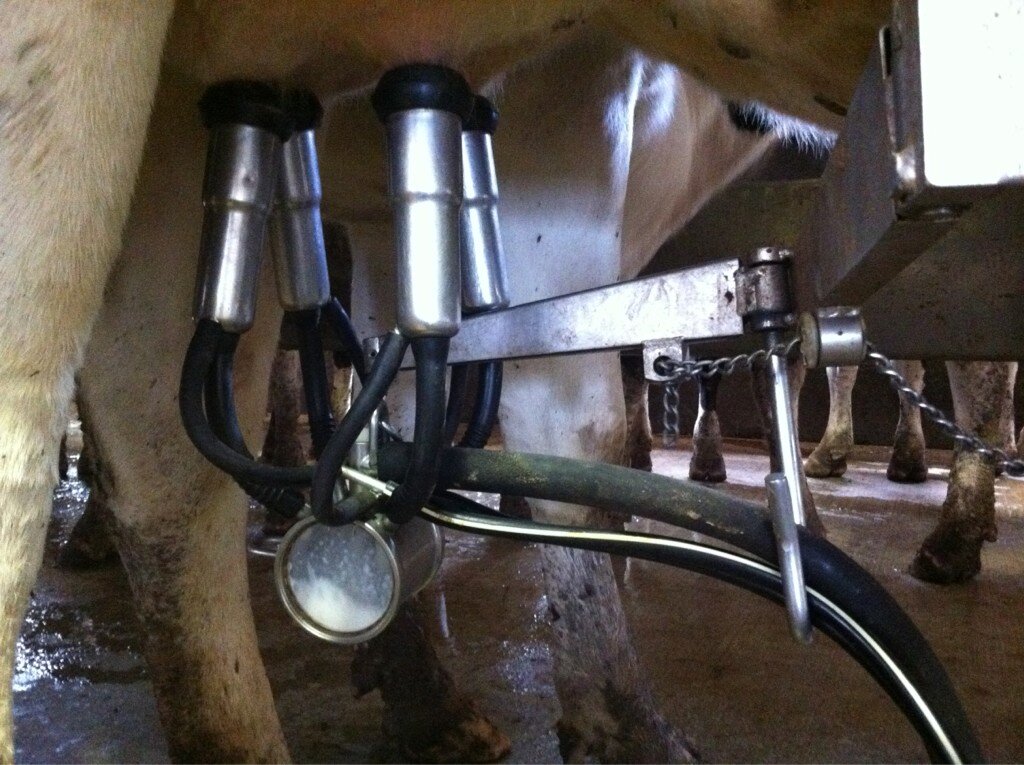
Answer: Yes, our milking machines have automatic take-offs which turn off and disconnect the units when a cow finishes milking. In our system, each cow's milk passes through a chamber that contains a pendulum. As milk hits the pendulum, air in another small timing chamber is released. As the milk flow slows to the point it no longer moves the pendulum, the pressure in the timing chamber begins to increase. Once that pressure climbs to a certain level, it triggers a series of valves that first shut off that milking unit's suction and then pulls the unit off and away from the cow's udder.


Until next time, thanks for reading and have a "dairy" good day!

Tuesday, August 19, 2014

Dairy Good Questions (8/19/14)

Welcome to the debut edition of "Dairy Good Questions", a new midweek feature in which I answer 2-3 questions people have asked about my farm or the dairy industry. Let's get right to it:


DGQ #1) "Will, do you have a favorite cow?" (via Whit Macknally)

Answer:  As a matter of fact, I do: Gilmer Dairy Farm cow number 859. She's big and tall, she's a good milker, she's as laid-back as a cow can be without being overly stubborn, and she never gives the first bit of trouble in the barn. She might not have strong idiosyncrasies like Ol' Number Seven had, but she does have her own spots where she prefers to stand in the barn and isn't shy about moving other cows out of "her" space. And unless she's on her way to eat, she always seems to appreciate a good head-rub. 


DGQ #2) "What's the milkfat/butterfat percentage of whole milk?" (via Josh Johnson)

Answer: Some of the milk in your local grocery store is identified specifically by the amount of butterfat it contains, such as 1% and 2% milk. Skim milk contains only traces of butterfat (< 0.5%) or none at all. Whole/Vitamin D milk, on the other hand, often doesn't give a clear indication of its butterfat percentage on the label. The federal minimum butterfat percentage standard for pasteurized whole milk is 3.25%, and most of it retails at or just slightly above this percentage. Exceptions include whole milk sold in California (3.5% minimum) and some brands of "cream line", or non-homogenized, milk. And while you might not find the actual butterfat percentage listed on a jug of whole milk, its nutrition label will include the grams of fat per serving along with information about protein, calcium, vitamins, etc. My advice is to drink whichever bf% milk you enjoy the most and adjust the rest of your diet accordingly, but do take time to compare labels and choose one that fits best within your overall nutritional plan. 

That's all for this week, but please let me know if you have a "dairy good question" you would like to have answered in the future. You can leave your questions via the comments section on this post, tweet them to me at @gilmerdairy, or post it to our Facebook page. Thanks for reading! 


Saturday, March 1, 2014

Show me your jugs...of milk!

As the Mardi Gras season enters its final weekend on the way to its (butter)Fat Tuesday finale, it's time for me to once again ask you to not only celebrate with parades, parties, King Cake and beads, but with milk as well. So in in the spirit of this festive time, I'm asking you to open your refrigerator, snap a photo of the dairy products stored within, and "show me your jugs"! Whether you have big jugs, little jugs, full jugs, near-empty jugs, mismatched jugs, or jugs of different shapes and colors, you can feel good about exposing them to the whole world and showing them that you value the taste and nutrition milk has to offer. And unlike some other "show me your (fill-in-the-blank)" Mardi Gras photos that may be floating around, you'll never have to have an embarrassing or awkward conversation with your family or coworkers about the milk jugs in your fridge.

nothing beats a nice, full rack of milk
Let's have some fun and raise a little dairy awareness while we're at it. Post a photo of your milk jugs to Twitter, Instagram, or Facebook, and be sure to include the #showmeyourjugs tag. And when Ash Wednesday rolls around, consider giving up soft drinks for Lent and replacing them with milk. With 8 grams of protein per serving and a wide variety of options for flavor and butterfat content, milk is a beverage you can feel good about pouring for yourself and your family.

Have a "dairy" happy Mardi Gras...now show me your jugs!

Monday, January 13, 2014

Saying Goodbye to Ol' Number 07

No.07 standing in her preferred milking position
This Monday we said farewell to our oldest cow, number 07.

Seven was born on July 30, 2000, just a few days before I started my final year at Mississippi State University. She gave birth to her first calf…a bull…and entered the milking herd on October 14, 2002. She went on to have nine more calves (5 bulls, 4 heifers) and produce over 180,000 pounds of milk in her lifetime. She was rarely ever a top-producing cow, but she was steady and sound and never gave a bit of trouble in the milking barn.

Many cows have physical characteristics, habits, or quirks that distinguish them from their herdmates, and Seven could check all three of those boxes. She was a thick, stocky cow with big, droopy ears, and she always preferred to be milked at the front unit on the west side of our parlor. And she hated the cow dogs…absolutely HATED the cow dogs.

Evidence of her anti-caninism first came to light the day she gave birth to her second calf. Though she never directed her aggression toward my dad and I, she chased both of our border collies out of the pasture when we tried to walk her and her calf to the barn. This happened three or four times, the dogs barking and retreating every time she took a step in their direction. From that day on she would glare at any dog that got within ten feet of her, often charging them if they made the mistake of not knowing where she was.

Our fondness for her and her antics (I once jokingly suspected her of leading an "Occupy Farm Lane" protest) helped contribute to her 13+ years of residency on the farm. She hadn’t been particularly profitable her last couple of lactations, but we kept her around for the sake of keeping her around. When our veterinarian informed us this summer that he didn’t think she would ever successfully calve again, we made the decision that we would “cull” her (sell her for beef) sometime within the coming months. That day came on Monday, January 13, 2014. By then her daily milk production had dropped below 30 pounds, she had developed a persistent case of mastitis (a mammary infection) in one quarter of her udder, and just wasn’t moving around as good as she used to. Typical of her lead-cow mentality, she was the first of the eleven cows we culled that day to load the trailer that would haul her off to the stockyard.  I have no way of knowing, but I imagine she probably fought her way to the front of the line for the ride that would take her from there to her next…and likely final…destination.


The idea of culling a dairy cow, especially one that has been on a farm for years, can seem harsh to those who have never owned or cared for livestock. But just like beef cattle, hogs, goats, etc., dairy cattle are food animals. Unlike some other types of livestock, they are meant to serve two distinct food production purposes: milk and beef. So no matter how fond we are of one particular cow or how much milk she’s produced for us in the past, she can’t reach her full potential to feed humanity by living out her final days on our farm. We will miss ol’ Seven and know we’ll never have another cow quite like her, but it was time for her to take the last steps toward fulfilling her complete purpose.

Friday, November 1, 2013

Real-time updates from the milking barn

Thanks to modern technology, I have the ability to share real-time updates about what is happening on my farm to a virtually unlimited audience. My favorite "on-the-go" social network is Twitter, and today I decided to tweet out how many cows we had milked throughout the course of this afternoon. It didn't take long before I started growing bored with it, so I decided I would try to share the information in a more creative manner.


Y'all have a "dairy" good weekend!


Tuesday, May 28, 2013

Cows, Antibiotics, and You

Raise your hand if you want to serve your family milk and dairy foods that contain antibiotic residues.

Yeah, I didn't raise my hand either.

The subject of on-farm antibiotic use has been coming up a lot in conversations lately. People want to know how it affects food quality and safety, as well as the possible long-term resistance issues that could be associated with their use. As a farmer and food provider, I have a responsibility to both my cows and my customers. The judicious use of antibiotics helps keep my cows healthy, and our quality-control procedures ensure that all of the milk that leaves our farm is safe, wholesome, and residue-free.

I recently wrote a blog post for the Food Dialogues website explaining the steps we take on our farm to strike the balance between herd health and food safety. As you read through it, I hope it clears up some questions you might have about our farm practices and the dairy products you buy.

Friday, March 8, 2013

GDF Vocowbulary: "Teat Dip"

Teat dip is an essential tool we use on every cow every time they come into the milking barn. So what is it (note- for what it is NOT, search my 3/8/13 twitter timeline for #teatdip)?  Teat dip is bacteria-fighting substance applied to a cow before and after milking. There are several different brands and formulations, but most that I am aware of use low levels of iodine as the active ingredient. Using teat dip helps to prevent mammary infections, thereby promoting good udder health and high-quality milk.

applying teat dip to a cow after she has been milked
As you'll see in the video below, "pre-dip" is applied and wiped off before a cow is milked. The pre-dip kills bacteria on the outside of the cow's teat. If left unchecked, that bacteria could work its way up into the teat during the milking process and cause an infection. An infection could then lead to lower milk quality, a decrease in milk production, health issues for the cow, and the potential need to combat the infection with antibiotics (at which point the milk would be "dumped" for several days). When the cow is finished milking, we apply a "post-dip". The post-dip accomplishes two things: 1) it fights-off bacteria until the cow's teat-end orifices can seal themselves off, and 2) it contains skin conditioners that help keep the cow's teats soft and supple.

I hope you enjoy this edition of GDF Vocowbulary, and maybe you will learn a little something about teat dip!


Tuesday, February 19, 2013

Our crazy schedule

If you're up and at 'em and scrolling through your Twitter timeline anywhere between 3-6am, there's a chance you've seen me shooting off updates such as "60 cows milked, 140 more to go" or "only 30 more cows standing between me and breakfast." I'm not sure if tweets like that have prompted it, but I have received lots of questions over the past few days asking why we milk the time of day we do.

Before I answer the questions of "why", let me first explain how our normal milking schedule shapes up. My dad and I handle the morning milking chores. The barn lights come on a few minutes after 3am, and by 3:45 the first cows are being milked. It usually takes us about three hours to milk 200 cows and wash the milking machines in the mornings, so lately we've been heading home for breakfast a few minutes before 7am. We start the afternoon milking around 1:30pm, and we're usually finished by 4:00.  

Most dairies schedule their milking shifts on even intervals...12 hours apart if milking twice a day, 8 hours apart if milking three times. We do it a little differently, though. Starting early in the afternoon means we're finished early enough to participate in whatever evening activities might be happening in our community. We extend our morning start-time beyond 12 hours from the previous afternoon because we'd each rather have five hours of continuous sleep than a couple of 2-3 hour naps on either side of the shift.

Not adhering to a normal milking schedule might cost us a little bit of milk production, but the "quality of life" we gain is worth it. We get more substantial rest at night, and we have more freedom in the evening. Thanks to our crazy schedule, my dad had the time to coach my youth baseball team when I was a kid, I have the time to help coach my son's team now, and we both have the time to attend meetings in town or basketball games over at Mississippi State. And trust me...our employees have NEVER complained about being finished by 4pm!