Showing posts with label weather. Show all posts

Friday, May 31, 2019

Farm Update - 5/31/19

It's been another hot, dry week on our farm, but we've managed to survive it and get a little bit accomplished along the way.

The most important thing going into this week was to get the last 35 acres of this year's corn silage crop planted down in our bottomland, and to that end we were successful. We spent the first half of the week getting the ground worked up and fertilized, and I spend Wednesday afternoon and most of Thursday running our four-row planter across the dusty fields. I looked back through my records and figured out that our five-year average planting date in those fields is June 2, so we beat it by a couple of days. That wraps up our corn planting for the year, and next we'll move on to a few acres of a pearl millet variety we are trying out. Well, we'll move on to that once it rains again and softens the ground a bit.

2019 corn silage crop...planted.

We really are starting to hurt for rain now. Our earliest planted corn is ready to be side-dressed but I'm hesitant to do it until we get some rain in the forecast. The fields look alright enough in the mornings, but as the sun starts bearing down it's obvious the corn needs a drink. Same goes with our pastures. I did help out one of the hayfields we harvested last week by spreading eight honeywagon loads of manure slurry on it this afternoon, and I imagine that will continue for a couple other fields on Monday and Tuesday.

On the cow side, we currently have 188 in the milking herd. The heat is driving them out of the pasture around mid-morning and into the loafing barn where they can cool down under fans and sprinklers. It's had a negative effect on milk production, but we're pretty much in line with where we expect to be this time of year. Milking times are running around 2.75 hours in the mornings and just over 2 hours in the afternoons.

cow no. 603 serving as a lawnmooer outside the milking barn

If you'd like to get all this information in a condensed, video form, be sure to check out the MooTube Minute I post at the end of each week. I used to post farm videos all the time, but both I and my viewers seemed to get burned out after a few years. I'm really enjoying easing back into it though, and hopefully it will help folks learn more about what happens around here.


And with that I'll bid you farewell. Thanks for your support, and have a "dairy" good weekend!

Tuesday, April 14, 2015

Catching up before we get caught up

Hello, y'all...it's been a while. After a long blogging hiatus attributed primarily to my preference to nap during meal breaks rather than type away on my old, slow desktop computer, I'm back to let you know what's been happening on Gilmer Dairy Farm and also with myself.

can't plant corn, but the grass is green
If there's one word I could use to describe the first 3.5 months of the year, it would be "wet". We're currently in a holding pattern of sorts, unable to begin planting corn or harvesting spring forages until we can string together several days of sunny weather. More rain is likely for the next several days, so we'll be out of the field for at least another week. Once we finally get favorable weather conditions for field work, I foresee some longer-than-normal days in my future.

On the cow front, we have been turning our cows out on grass for supplemental morning grazing over the past three weeks. We currently have 212 cows milking, and they are holding steady at an average of 66 pounds of milk a day each (we peaked at 70 last month). We won't be having many calve or dry off in the next few weeks, but we'll start seeing some turnover by late May. Meanwhile, it's time for our younger heifers to receive their vaccination boosters, which we started administering today.

Personally, I'm about as "free" as I have been in a while. My term as one of USFRA's "Faces of Farming and Ranching" came to a conclusion at the end of last year, and I am no longer a part of any other groups that would have me traveling on a regular basis. And I'm telling you, it sure is nice to take a step back for a while! I'm getting more done on the farm, spending more time with my wife and kids, and will hopefully be a little more visible around our community. I might even be able to set aside enough time to play golf once a week...though I doubt it. 

Between now and whenever I blog again, I'd love for you to connect with me via the social media channels over on the right side of the page. You might even catch me live streaming on Periscope if you play your cards right (and have an iOS device). And for you locals, let me know if you'd like me to come talk to your group about my farm or farming in general one evening...I'd love to do that once or twice a month once we get caught up on our farm work. Until next time, y'all have a "dairy" good day.

glad to be spending more time
with my cows and my kids

Tuesday, January 28, 2014

We Survived the Snowpocalypse

After surviving the "Deep Freeze of 2014" earlier this month, we've had to brace ourselves and our farm for yet another blast of frigid Arctic air. The temperature may not fall quite as far or remain below the freezing mark for as many consecutive hours as it did previously, but today's weather brought a menace the first hard freeze did not. I'm talking about that four-letter word that the mere mention of will send people rushing to their local grocery store to buy all the milk (a good thing!) and bread they possibly can. I'm talking about cloud dandruff, The White Death,...SNOW.

Lamar County snow drift, 1/28/14
As you can see in the photo to the right, snow drifts developed along the side of the county road between my house and the dairy barn. Driving conditions were treacherous, making my 0.6 mile commute seem like a 0.65 mile drive. But despite all the problems caused by the snow and freezing weather, the cows had to be milked.

And milk them we did.

The cows didn't seem to mind the weather one bit. Save for a few slobbersickles (and one very impressive, four-inch long boogersickle), you would have never known by looking at them that it was a miserably cold day. Two or three small sheets of ice formed in the back of the milking barn prior to the cows' afternoon arrival, but they quickly melted. We did have one incident in which slow-moving traffic in the milking barn's outbound lane caused a significant back-up, but we did not attribute it to the same conditions that stranded thousands of motorists on Alabama highways today.

"Slow traffic has caused a back-up in the outbound lane. Authorities say it is not weather related, just cows being cows."

On a serious note, a "dusting" of snow might be an over-exaggeration of what we got this morning. The freezing temperatures have and will cause a few problems and delays around the farm, but the snowfall proved to be inconsequential in our area. But even if the "worst-case" winter weather scenario were to befall us, we would do whatever it takes to keep our cows fed, watered, and milked. That's the way it has to be, and that's the way it is!  

Saturday, January 11, 2014

We Survived the Deep Freeze

With the temperature expected to hit the 60° mark later today, I think it's safe to say we survived the "Deep Freeze of 2014".

cows showing off their "slobbersickles"
on the coldest morning in 17 years
As we expected, frozen water troughs and frozen milking equipment were the two major problems we addressed during the sixty-hour freeze from Sunday night through late Wednesday morning. Keeping fresh water available in our pastures proved not to be too terribly time-consuming, as busting and pitching out the surface ice in troughs once a day was generally sufficient. On the other hand, freezing milking equipment did put us behind the first three mornings of the week. Before we could milk our cows on a 7°F Tuesday morning (coldest temp since '96), Dad and I spent an hour thawing milk lines, pneumatic valves that power the equipment, and part of the vacuum system. Monday and Wednesday weren't quite as bad, each requiring only 30-45 minutes of pre-milking maintenance.

Who was that masked man?
I guess the most important thing through it all was that neither our cows nor we were ever in any danger of suffering cold-related health issues. Cows can handle temperatures well below 0° provided they have plenty to eat and drink, stay dry, and can get out of the wind, all of which ours did. And we were smart enough to wear plenty of layers and not stay out in the open for too long in cold we simply aren't used to. My fingers and toes got a little numb a few times, but far from anything serious.

We are less than two weeks into January, so there is certainly time for another round of unusually frigid air to make it this far south. After working through what we did earlier this week, though, I don't have any doubt we can adjust our daily schedule and farm chores to successfully deal with it. 

Saturday, January 4, 2014

Baby it's Cold Outside

The new year is finally here, and we're ringing in the first week of 2014 with 210+ cows in the milking herd, a pay-price of over $20 per hundredweight of milk, and cold, cold weather.

I realize that "cold" in the Southeast isn't exactly what it is in other parts of the country (Minnesota, for example), but I've been wearing my long-johns just the same. We've had a little taste of freezing weather the last couple of days, but the really cold air is on its way and should arrive Sunday night. Once it gets here we won't see the mercury climb above 32° until Wednesday afternoon. The low point looks to be around 8° before sunrise on Tuesday...yikes!

Our main concerns during periods of below-freezing temperatures center around water. Troughs are going to freeze over, so we will have to bust ice to let the cows get to the water underneath. We will also have to use hot water to thaw frozen supply faucets in order to refill the troughs. Frozen wash lines in the milking barn are likely to be a problem, too. Sanitation is critical on a dairy farm, so keeping the wash system thawed and working properly will be a top priority. I spoke with WCBI-TV about these weather plans on Saturday:


We've made it through longer periods of even colder weather before, and we'll get through the next few days too. The cows and heifers will be just fine as long as we provide them with water and haul hay for them to munch on, the milking equipment shouldn't take too long to thaw out, and we will be bundled up at least four layers deep. Still, I sure will be glad when Spring finally rolls around!

Tuesday, August 20, 2013

Wet hay say, "Bale another day."

I've always heard that the ideal time to cut burmudagrass hay is 30-35 days after the previous cutting. Well, that's exactly what we did with 52 acres of the stuff last Thursday and Friday. At the time, the weather forecast showed a fair chance of rain on Saturday, and then nothing greater than 20% before the chances rose to 50%+ during the second half of this week. Our thought was that it would have enough time to dry even if it did get a little wet Saturday, and we should have it all baled and hauled out of the fields by the end of Wednesday.

It stayed cloudy but never rained on Saturday. Meanwhile, the greater rain chances shifted to the first of the week.

We got 0.1" of precipitation during an afternoon-long mist/drizzle on Sunday. The not-fully-dried-out hay was now wet.

We never saw the sun on Monday, but we did see a couple of short downpours. Needless to say we never made it into the hayfield.

By midday today we were finally getting enough sunshine to start giving it a try. I spent 3.5 hours "fluffing" some of the hay with the tedder to speed up the drying process, and by 4pm the first 10 acres was dry enough to bale.  As luck would have it, though, a stray rain shower found its way into the field just as the hay rake and baler were doing the same. Once again, hay baling must be postponed another day.

I guess there are two things that we can learn from the events of the past few days. First of all, never place too much faith in a weather forecast beyond three days. And secondly, a farmer can ALWAYS find an opportunity to complain about the weather, even in the midst of one of the best summers weather-wise in recent memory.

Monday, August 19, 2013

Summer Break is over

For the first time since late May, my wife and kids were up and ready to go before I made it back home from the morning milking. Yes, today is first day of the new school year.  Summer break is over, and, coincidentally (or not), so is my hiatus from this blog.

another cloudy, damp August morning
The story over the last 10-12 weeks has definitely been the weather. Other than a dry stretch during the second half of June, we've had more than adequate amounts of rainfall and the summer heat hasn't been nearly oppressive as normal. In fact, I dare say we've had a few days of very "comfortable" weather this summer. Though late getting it planted, our silage crops look to have taken advantage of the extra water, and our first cutting of bermudagrass hay was outstanding. The second cutting is currently on the ground, but yesterday's drizzle and this morning's clouds will likely either delay or postpone the baler going into the field.

Well, it's 7:30 and time to get back to work. You can follow me on Twitter (@gilmerdairy) for a "play-by-play" of the work day, and I'll occasionally post a photo or short farm video there, too. So until next time, y'all have a "dairy' good day!

Thursday, January 17, 2013

Snowy morning on the dairy farm

We've finally had a change in the weather after days and days of rain...it snowed this morning. It was actually drizzling early when we started milking, but the rain gave way to snow just before dawn. It was coming down pretty hard for a little while, but for the most part had stopped by 10am.  We may get another flurry or two through early afternoon, but it should all burn off as the clouds move on to the east and we get a little sunshine for what will seem like the first time in 2013.

snow falling on a wheat field

"What is this white stuff?"

snow in Lamar County = no school = happy kids


Thursday, December 22, 2011

Rainy day dairy chores

Without exception or excuse, every day is a work day on our dairy farm. We'll rack up between 7-8 hours of actual working time even on days when we cover only the basics (milking and feeding). On a cool, rainy day like today, it would be nice to get off so lightly...handle half the chores before breakfast and the other half after lunch. But when we have other things that need to be addressed, we address them regardless of the weather.

my dad inspects heifers for signs
of estrus on a rainy morning
This morning won't go down as one of our most productive, but we did get a few things taken care of.  We sorted out and bred three heifers before retreating into the barn to repair a gate-opening pneumatic cylinder and two water trough floats. We also had to treat a cow for milk fever by giving her an IV of CMPK solution. We held off on making the feed rounds through the heifer pastures until the rain slowed to a drizzle, but as luck would have it the bottom fell about as soon as the guys pulled away with a truck full of feed.  One they finished, we knocked off for lunch a little early so we could all have a little extra time to dry out our work clothes.

Lunchtime is over, so I guess I'd better slip back into my damp overalls and head over to the dairy barn for the afternoon milking. A dairyman's gotta do what a dairyman's gotta do!


Saturday, December 17, 2011

This week's farm photos

I'll never be mistaken for a photographer, but I enjoy snapping a few farm photos with my phone's camera every now and then. I've been playing around with the Instagram app on my phone lately and have posted some of those photos below. There's no rhyme or reason to why I used the filters I did, I just thought they looked good on my screen at the time. And since I'm a farmer and not a photographer, the accompanying descriptions are about the photo subjects instead of the photos themselves.

We bred (via artificial insemination) a group of 35 heifers over the course of the first two days of December. This was our first foray into the world of sexed semen, which we used on 80% of the group. The heifers that did not conceive after breeding should be coming back into estrus this coming week, so we'll have a second chance to AI them before pasturing them with a bull after the first of the year. 

They, like all of our heifers, are getting a steady diet of bermudagrass hay and mineral blocks to supplement the pelleted feed we're giving them each day.


When I published this photo of two dry cows over my Twitter account, I captioned it "Hanging out in the maternity pasture". I got a couple of responses from people who told me they didn't realize there was such a thing. Many farmers have barns for their cows to calve in, but we have enough pasture space (and suitable weather) to allow our cows to comfortably and safely give birth outdoors.

We currently have seven dry cows and pregnant heifers in the maternity pasture and will be adding more from another pasture on Monday.


Friday, June 3, 2011

Friday farm tidbits

Happy Friday and happy June Dairy Month everyone!  Here are a few tidbits about what's been happening on and around Gilmer Dairy Farm:

It's HOT, Man! - The weather around here has been brutal this week as we've seen record-breaking temperatures push into the upper 90s with afternoon heat indexes well over 100.  We're running 8-10 degrees warmer than normal for this time of year, and trust me when I say you can definitely feel the difference.  The cows are feeling it too, despite our best efforts to keep them as cool as possible with fans & sprinklers. More on this in a moment.

the official drought is still to our south
It's DRY, too! - We aren't officially under drought conditions according to the latest US Drought Monitor, but we are eight days past our last rain and have only received a total of 0.4" over the past three weeks.  The soil moisture in our bottom land is still good enough to get our corn growing thanks to a wet winter and spring, but our fertilized hayfields and pastures are basically doing nothing.  We also can't begin planting our forage sorghum crop until we get enough rain to soften the soil.  If there is a bright spot in the dry weather, it is that it's better for the cows. Why? Throw in lots of moisture with this kind of heat, and cows will wallow-out mud holes in the pasture and run a higher risk of mammary infections.

the milk decline is udderly depressing
Milk production is FALLING! - The cows seem to be producing less and less milk every day. The heat is a major factor, but there are a couple of other factors as well. We're entering the summer with the youngest herd (based on avg. lactation number) we've had in 5 years, so our overall potential production isn't quite as high as it would be with older cows. Also, we have the highest average days-in-milk and days-pregnant we've had in 60 months. This means that an average cow in our herd has been milking for over seven months, is 5 months pregnant, and her milk production would naturally be in decline. The heat stress and related loss of feed intake (like most of us, cows don't eat as much when they're hot) speeds up that decline.  Our milking herd currently stands at 186 cows and will continue to shrink to 165-170 until we begin "freshening" more cows than we dry off sometime mid-Summer.

Nutrient & Pest Management - The dry weather has given an opportunity to spread fertilizer on hayfields and kill weeds in a few pastures earlier this week. The last couple of days we've been working on building a 3-point hitch mount for our 30-foot sprayer boom. If all goes well it will be field-ready by the end of the day, and I'll spend much of next week applying a post-emerge rate of Atrazine in our corn fields and glyphosate in our sorghum fields.

me & my boy
Tee-Ball & Graduation - In the "farm family" category, there are a few things that are coming to an end.  School is now out for the summer, so my wife will enjoy being able to stay home for a couple of months. On a side note, I hope this also means that I get a better quality lunch everyday for the next couple of months!  Secondly, our twice-weekly trips to the ball field will be on hold until next spring now that our 5 year old's tee-ball season is over. I had a lot of fun helping coach his team, and it was gratifying to see how much he and his friends improved over the past couple of months. Best of all (and most importantly at their age), the kids seemed to have fun from start to finish. And finally, our son will "graduate" from pre-school tonight, which just happens to be the 11th anniversary of mine & my wife's first date. I'll tell you what, time sure does fly when you're having fun!

I hope you all have a great weekend, and that the weather is agreeable to you wherever you are. Don't forget to celebrate June Dairy Month by enjoying lots and lots of nutritious, delicious dairy products!  And remember...there's only one more week to enter our farm's Milk Mustache Contest.  We've had some great winning photos in the past, and expect the same this year.  If your kid loves milk and you think he or she has what it takes to be our Milk Mustache "poster child" for the next year, hurry up and grab your camera, pour one more cold glass of milk, and get some photos coming my way!


Tuesday, May 31, 2011

Spreading fertilizer and waiting for rain

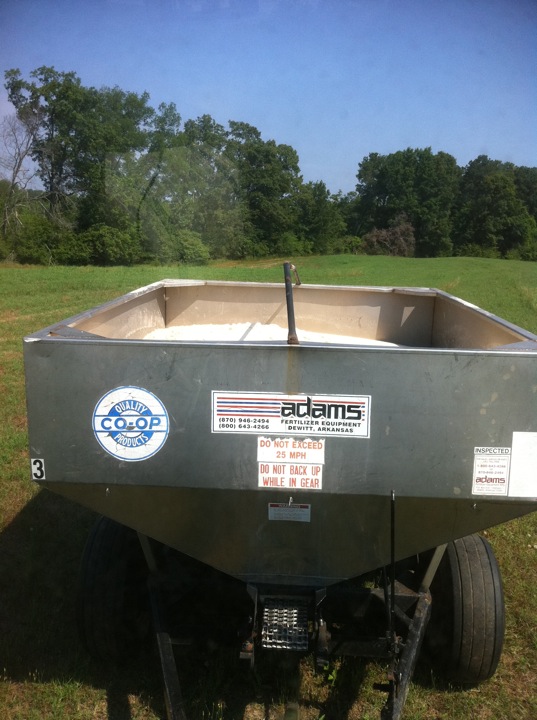
The local co-op delivered a fertilizer buggy full of ammonia nitrate to our farm this morning, along with 900 pounds of 0-20-20 in bags. I spent most of the morning pulling the buggy across hayfields (still 3 more acres to go) while one of our employees spread a mix of the bulk and bagged fertilizer on a few acres of our bottomland that was too wet for the spreader truck to cross last week.

We aren't really hurting for moisture down in the bottomland.  The corn we planted last Wednesday has already emerged, and it looks as if we'll have a good stand down there.  The land around our dairy is a different story though.  Our hayfields are green, but the bermudagrass isn't growing as quickly as it needs to due to a lack of water.  The current forecast calls for a slight chance of thunderstorms Saturday through Monday, so hopefully three days of 30% equal a 90% chance we'll get at least one shower.

Regardless of if we use a no-till or minimal-till method to plant our forage sorghum, that job is also on hold until we get some rainfall.  Our target date for planting had been mid-June, and that's still a possibility if we get any substantial rain within the next 10 days.  We do have a fairly forgiving planting window on the sorghum, though, as we've planted it successfully as late as early July.

So until it rains, we'll tinker around in the shop, maybe spray a few pastures, and keep the cows as cool and comfortable as we possibly can as the heat creeps towards 100 degrees later this week.  

Friday, October 8, 2010

Still waiting on the wet stuff

We're still facing dry conditions here on the farm, and our fall forage planting will continued to be delayed until a fair amount of rain can fall. The US Drought Monitor currently has us designated as D0, or "abnormally dry". I expect that we'll be bumped up to the moderate drought category next week unless the weather makes a big change.

In the meantime, we're still finding plenty of things around the farm to keep us busy. For one thing, the drier weather has allowed us to do some much needed brush cutting in a few spots. It has certainly improved the looks of the place, and it will give our heifers a few more acres of "clean" ground to pasture on this winter.

And, of course, our cows still demand a lot of our attention. We are currently up to 182 milking, but we'll cut that down this afternoon as we have a few to dry off. Their milk production continues to climb, thanks in part to the improving quality of their corn silage as we get deeper into the bunker. We're also letting our animals graze down the remaining sudex on the farm, with the milking herd spending late mornings in one large paddock and our dry cows picking through a 10 acre field.

Thursday, September 23, 2010

It's still summertime on the farm

Even though it is now technically "Fall", the continued dry weather and heat would certainly make a person think it's still summertime. Our milking cows are still coming to cool in the barns by mid-morning, the bermudagrass in our pastures is starting to fade away, and our tall fescue has yet to begin its autumn growth-spurt.

We've decided to move some of our larger animals off of some heavily grazed and drought-stressed land and onto greener pastures...literally. We consolidated a group of pregnant heifers and dry cows (all due to calve after the first half of November) this morning into a pasture that includes a 20 acre hay field that was attacked by armyworms a couple of weeks ago. That bermudagrass won't grow back enough to justify cutting it for hay, but it has thickened up enough to make for some good grazing. There is a 10 acre field of sudex regrowth adjacent to the pasture that will also available for grazing for another 2-3 weeks.

Speaking of sudex, the weather has been ideal for curing it into hay. I mowed six acres of regrowth in a grazing paddock (that hasn't been grazed lately) on Monday and flipped it today with the hay rake. It should be ready to bale early tomorrow afternoon and will be fed to heifers or dry cows this winter.

If the current weather forecast holds we should be getting a break from the heat and maybe a little rain early next week. If so, it will be good for our cows and certainly for our pastures, and it will move us a little closer to planting our cool-season forages like rye, oats, and ryegrass.

Don't forget our Edopt-a-Cow program, and have a "dairy" good day!

Tuesday, August 3, 2010

It's hot, but we're still farming!

As you can see by Accuweather.com's forecast on the left, it's going to be another HOT one here on our dairy farm. Looking at the extended forecast, we're not going to get much of a break, either. We should cool down to the mid-90's (yeah, BIG change) by the end of the week, and right now we have small window in which we might get some rain either Friday or Saturday.

Regardless of the terrible heat, dairy farming is a 365 day a year job so we'll be right out there in it doing the best we can. Our cows, fortunately, have been getting enough relief from the fans and sprinklers in our barns to keep from showing too many ill-effects of the heat. Sure, their milk production has dropped, but we have yet to see any health problems we can attribute directly to the heat. We are sending a half-dozen cows to the stockyard this morning (dairy cows provide beef, too!) and should be milking 194 this afternoon.

Our corn silage harvest continues and is hopefully nearing completion. We'll be servicing our harvesting equipment first thing this morning before moving it to the final 22-acre field remaining to be cut. A field that size could be harvested in just a few hours with the right equipment, but it'll take our 2-row chopper close to two full days to harvest the terraced, contoured field. Hopefully the old thing will hold together so we can be finish sometime tomorrow afternoon. Once we've finished with the corn we'll jump right into 50+ acres of bermudagrass that's ready to be made into hay.

If you would like to see our silage chopper in action, check out our latest MooTube Minute. Try to stay cool, and prayers for rain would be greatly appreciated!


Monday, June 21, 2010

a hay update

We've spent several hours in the hay field lately, so I thought I would give you a quick update on our progress.

Our first bermudagrass hay was cut two weeks ago, and at the time it looked like the weather forecast would be favorable to bale it two days later. Well, things changed, and what started out as a "30% chance of isolated showers late Wednesday" became a half inch of rain at 8:00 that Wednesday morning. That was followed by another 3.5 inches that evening. We did get the hay dried out and raked at the end of the week, but my dad didn't get halfway through baling it on that Saturday before a belt broke on the baler. We got it fixed the following Monday, and wound up with 96 bales off of 17 acres. Not bad considering the conditions.

We put the mowers back on the tractors last Thursday and set out to cut another 18 acres. The hay would have been ready to rake and bale Saturday afternoon. But again, dry hay on the ground is a great magnet for rain. We dodged the big rains and didn't get much more than a sprinkle, but it was enough to keep us out of the field that day. So, while I spend Fathers' Day afternoon in the milking barn, my dad spent it in the hayfield with the rake and baler. By the time he was finished, he had rolled 147 bales (nearly 3 tons per acre). I haven't gone back into my files, but I think that's the most that field has ever yielded on one cutting.

So, coming into this morning we had 243 bales from 35 acres, with 40 more acres to go. We got the hay mowers rolling about 10:30 this morning and covered all the ground by 5pm. The three fields we cut today have some spots of invasive crabgrass which won't dry out nearly as quickly as the bermudagrass, so we'll have to "fluff" it with our hay tedder tomorrow or Wednesday before we rake it. Hopefully for once we can avoid the rain until we have it baled later this week.

And THEN maybe we'll get some rain to get it all green and growing again!

Monday, April 26, 2010

Dodged the Tornado...again.

I'm sure most of you are aware of the severe weather that rolled through the Southeast this past Saturday. The storms spawned tornadoes that claimed several fatalities and did millions of dollars worth of damage.

There were several different "waves" that came across the state, the first being the system that contained the killer tornado that struck Yazoo City and Choctaw County, Mississippi. And much like the tornado that hit Weir and Caledonia in January 2008, we were at the farm watching and listening to weather reports warning us that it was coming right for us.

The storm in 2008 did pass directly over us while we were milking. Once it got about two minutes away from us, we shut off all of our milking equipment and hunkered down in our pit-style parlor. The tornado had picked back up into the clouds, thank goodness, but the driving rain and howling wind certainly had our attention. This weekend's storm wasn't nearly as dramatic by the time it reached us. We finished our work at the dairy about fifteen minutes before it was projected to cross between Vernon and Sulligent, and as it got closer it progressively tracked further to the north. There was hardly any rain with it, allowing me to stand on my front porch and clearly see it approaching from the west. I even posted a couple of pictures of the system to Twitter and found out later that a television station in Birmingham showed them during their coverage.

We did get hit by a thunderstorm about an hour after the first system passed by, but the heavy rain and strong winds only lasted a few minutes. After that, we never saw more than an occasional gust of wind and light rain as the rest of the severe weather stayed clear of us.

We've weathered quite a few storms over the last few years, and we're lucky to have escaped them all with no injuries to us or our cattle and very minimal damage to any of our property. Our luck may run out one of these days, but for now I'm happy to say that we dodged the tornado...again.


Wednesday, February 10, 2010

Silage, mud, and TV

Last week we finally began feeding our milking herd the sorghum silage we harvested last fall. It looks pretty good and the cows seem to be enjoying it, but we haven't gotten a forage analysis run on it yet. We'll be calling our nutritionist to take care of that in the next few days so he can adjust the composition of our dairy feed to balance out with the silage. We've used up all the sorghum-sudangrass baleage that we had been grinding in their feed ration, so we're now down to the silage and dry bermudagrass hay as the only forage available to them. Unfortunately for us, we're using our hay (for milk cows and heifers) at such a rate that we'll run out of it before our spring forages and pastures begin putting out enough growth to sustain grazing. So our options will be to either truck in alfalfa from the Midwest or find a more local source of quality bermudagrass hay. The latter is more than likely what we'll do, but either way it'll be an added cost to what already is an expensive feed recipe.

One thing it looks like we won't run out of is mud. Our ground has been incredibly wet ever since September and all the rain we've had is really taking a toll on our pastures. A lack of sunshine has also slowed the growth of our cool-season grasses as well. We had hoped to be intensively grazing our milking herd by mid-March, but the weather is really going to have to change quickly for that to be possible.

Before I sign off, I would like to quickly address a couple of news stories you may have seen on network television lately. ABC's Nightline program recently aired a segment calling the ethics of dairy management practices into question, and the CBS Evening News is currently running a two-part series about the use of anitbiotics in livestock. As a farmer, I get pretty frustrated watching stories like this because I know they don't accurately portray what most of us are really doing on our farms. At the same time, I expect the general public to have lots of questions about food production after watching these stories. This really underscores the need for myself and other farmers to proactively engage with our customers about our on-the-farm practices, and I hope they'll be willing to give us a chance to address any concerns they may have before they form their opinion strictly on what they've seen on TV.

Well, my breakfast break is over and it's time to get to work. I hope you all have a "dairy" good day!

Friday, January 22, 2010

At Capacity

Our current milking herd is now up to 230 cows thanks to lots of calvings and not many dry-offs, and we've still got 20 more head expected to calve over the next four weeks. While this may sound great, it's going to prompt some tough management decisions on our part.

If you've been keeping up with us over the last few months you'll recall that we had a very poor silage harvest due to the weather in September and October. We've fed the milk cows nearly all of the sudex baleage we harvested and will be switching them over to sorghum silage within a couple of weeks. When we look at the estimated amount of silage we have stored and how much we think we'll have to feed per cow each day, it's unlikely that our supply will be enough to carry this many cows through until our spring forages have been harvested and ensiled.

Right now it appears our best option moving forward is to reduce our milking herd size. We have several pregnant cows that are still several months away from calving that aren't producing very high above the profitability line. We can go ahead and dry some of these off early (we typically dry off cows 2 months prior to calving) and let them eat bermudagrass hay and graze tall fescue. We can also go ahead and move some more cows into the beef market earlier than we would typically do.

The next couple of months are going to be pretty interesting, and the weather will play a huge factor in the decisions we make. If the weather is well suited for growing and grazing our forages over the next few months, we should be able to make it fine without having to cut our numbers by a whole lot. Otherwise, we'll probably be looking at heavy culling, selling a load of cows or heifers to another dairy, and buying additional forage.

Tuesday, January 5, 2010

It's freaking cold, man!

It is not supposed to be this cold in northwest Alabama!

Tonight will be our second straight dip down into the mid 'teens, and after tomorrow's "warm-up" (high of 40, low of 25) the temperatures fill fall even more on Thursday. Once those temps drop below freezing Thursday afternoon they won't break the 32 degree mark until Sunday afternoon, and we're expected to see single-digit lows at least twice during that streak.

Now, I realize that this weather would be a welcomed relief to many of you up North who have much colder weather on a regular basis. You're used to it, and your farms were probably designed to handle prolonged cold weather. Our dairy farm, like most in the south, are designed to provide optimal cooling during the summer months. Unfortunately, what's good for the summer isn't too great for the winter.

So, we'll keep the ice busted off the tops of our water troughs and thaw out our milking equipment twice a day until a more typical winter returns next week. And if you're wondering about how our cows are doing in this weather, they're happy as long as it's dry and they have plenty of feed and water. You can learn more by watching our latest MooTube Minute below.