Showing posts with label food. Show all posts

Tuesday, July 13, 2021

Recapping our family trip to Nashville

My wife, kids, and I made our first family trip up to Nashville last week. It wasn't really a vacation in a classic sense (I was there for a conference), but we had a good time over the two and a half days we were in town. 

After settling into our downtown hotel room late Thursday afternoon, we made the short walk over to Nissan Stadium to attend Nashville SC's match again Atlanta United. For all the soccer my son and I watch on television, it was our family's first time to attend a professional soccer match. We. Had. A. Blast! NSC had to settle for a 2-2 draw after two of their goals were disallowed, but we had too much fun to care about the result.

Friday's conference agenda called for a morning meeting and evening dinner, leaving us with a free afternoon. We ventured to The Row Kitchen & Pub on Lyle Avenue for lunch where we all ordered the Nashville Hot Chicken. It did not disappoint. From there we made the short drive over to Centennial Park and spent an hour touring the Parthenon. After returning to our hotel, we walked a few blocks to get ice cream and cookies at Mattheessen's.

We enjoyed a late lunch Saturday afternoon at Puckett's Grocery & Restaurant on Church Street. The Country Music Hall of Fame was next on our agenda, and I really enjoyed all the different exhibits that walked you through the origins and evolution of country music. After returning to the hotel room for a nap that we all needed, we finished the day eating supper at a little place in the Germantown district called Jack Brown's Beer & Burger Joint. If you ever find yourself there, you can't go wrong with the Dr. Gonzo burger and sweet potato fries.

One day I'd like to go back to Nashville and take in more of the live music scene with my wife, but I'm thankful for the quality time the four of us spent together this past week.

The Parthenon at Centennial Park, Nashville


we enjoyed watching Nashville SC play at Nissan Stadium


inside the rotunda at the Country Music Hall of Fame


the Dr. Gonzo burger at Jack Brown's


life's better with ice cream

Friday, September 13, 2013

I'll have a burrito with extra salsa, hold the bull****

I had every intention of taking a nap during my lunch break today, but I made the unfortunate error of clicking a link to Chipotle's new video promoting their "Scarecrow" game.

Sigh.

Once again, a restaurant chain is vilifying and grossly misrepresenting the way that most farmers raise food. I guess they have to manufacture enough contrast to make what they sell appear to be the far superior (both nutritionally and ethically) food that it really isn't. But I have to hand it to them, it's a good marketing strategy that really strikes an emotional chord. If I didn't know anything about agriculture and was willing to take their word for it, I'd probably buy in to their message.

Milking time at Gilmer Dairy Farm
I could probably spend two hours angrily pounding out a thorough rebuttal, but I have dairy cows to tend to and a crop to harvest this afternoon. While I'm doing that, I would encourage you to look around this blog, my farm's website, and our YouTube channel. You can follow me on Twitter, too! Then check out a few of the many, many other farmers who are sharing their stories over the internet and social media. Once you do, I think you'll see that modern agriculture and the way we go about the business of producing food looks nothing like the horror story Chipotle and others (I'm looking at you, Panera Bread) is trying to scare you with.

In closing, I have heard that Chipotle serves some really tasty Mexican food. I might give them a try someday and order a burrito with extra salsa...but only if they'll hold the bull****.

Friday, March 8, 2013

GDF Vocowbulary: "Teat Dip"

Teat dip is an essential tool we use on every cow every time they come into the milking barn. So what is it (note- for what it is NOT, search my 3/8/13 twitter timeline for #teatdip)?  Teat dip is bacteria-fighting substance applied to a cow before and after milking. There are several different brands and formulations, but most that I am aware of use low levels of iodine as the active ingredient. Using teat dip helps to prevent mammary infections, thereby promoting good udder health and high-quality milk.

applying teat dip to a cow after she has been milked
As you'll see in the video below, "pre-dip" is applied and wiped off before a cow is milked. The pre-dip kills bacteria on the outside of the cow's teat. If left unchecked, that bacteria could work its way up into the teat during the milking process and cause an infection. An infection could then lead to lower milk quality, a decrease in milk production, health issues for the cow, and the potential need to combat the infection with antibiotics (at which point the milk would be "dumped" for several days). When the cow is finished milking, we apply a "post-dip". The post-dip accomplishes two things: 1) it fights-off bacteria until the cow's teat-end orifices can seal themselves off, and 2) it contains skin conditioners that help keep the cow's teats soft and supple.

I hope you enjoy this edition of GDF Vocowbulary, and maybe you will learn a little something about teat dip!


Friday, January 25, 2013

Honored to be chosen as a "Face"

USFRA consists of 70+ farmer/rancher-led
organizations and agricultural partners
 
This week I was honored to be introduced as one of the US Farmers & Ranchers Alliance's "Faces of Farming & Ranching". Along with fellow winners Bo Stone, Chris Chinn, and Katie Pratt, I'll have opportunities to represent the USFRA and our nation's agriculturalists as we engage in insightful conversations about our food system.

Food is obviously a basic need we all share, but our views on its production and preparation are often quite different. My goals this year are to share how our farms and ranches are continually improving production methods, learn more about the factors that drive people's food choices, and build upon common ground when discussing our food system's most oft-debated issues. And whether you adhere to a strict diet of organically-raised fruits and vegetables or enjoy occasionally slapping some PB&J between a couple of oatmeal creme pies, I hope you'll join the conversations we'll be having about food production, safety, quality, and choice.

Thanks for all the encouragement and support up to this point, and I covet both as I move forward in this new role.

Related links/video:


Friday, January 11, 2013

Happy National Milk Day!

It's January 11th, which can only mean one thing: today is National Milk Day!

Ok, I'll admit that I didn't have it circled on my calendar. In fact, I didn't even realize it until someone tweeted me about it after breakfast. Once I knew about it though, I felt it was my dairy farming duty to promote the heck out of it! I've posted a coupled of things about it on Facebook, solicited people to "#showmeyourglass" on Twitter, and now I'm cutting out my lunchtime nap to let you know about this great occasion here on my blog.

How should you celebrate National Milk Day? Well, the obvious answer is to enjoy a glass of the good stuff. And by "the good stuff", I mean the REAL stuff...not that soy/almond/coconut/hemp nonsense. You can pour up a glass of "whole" milk, 2%, 1%, skim, lactose-free, chocolate, strawberry, or any number of other varieties available. You can also celebrate by cooking up something that calls for milk in the recipe, donating shelf-stable milk to your local food pantry, or expressing your appreciation to a dairy farmer you might know. I'd love to hear a story or see of photo of how you celebrated this great holiday!

I hope you enjoy milk today and every day, both for its taste and nutritional benefits. Most of all, I want to thank all of you milk drinkers and dairy lovers out there. It's because of your support that I get to raise my kids on a farm, work with my family, and do what I love to do every day. So I raise this tall, cold glass of milk in your honor...Happy National Milk Day, and Cheers!


Thursday, January 26, 2012

FAQ: "What's the difference between conventional and organic milk?"


Over the past few years, several of my friends have asked about the difference between conventional and organic milk.  There is A LOT of information available on this subject, so I won’t try to reinvent the wheel here.  I’ll simply give you an overview along with my take on the issue.

To start with, the terms “conventional” and “organic” refer to a farm’s method of production, not the actual milk. For a dairy to attain UDSA organic certification, it must fully incorporate and adopt a set of production methods that include a variety of specified “cultural, biological, and mechanical practices.” Guidelines include provisions on how often cows graze and have access to pasture, how their additional feed must be grown, and how their health is managed (read this USDA Factsheet for more info). Most dairies include some of the listed practices as part of their own standard operating procedures, but are considered “conventional” because they haven’t adopted all of the USDA’s organic guidelines.

"What do you mean we're not organic?
We're carbon-based life forms!"
A farm’s decision to use conventional or organic production methods is rarely as black and white as a Holstein dairy cow. Herd health, the availability of (or capacity to grow) feed, economics, and location are just a few of the factors farmers must take into consideration. Ultimately, dairy farms are going to use production methods that best allow them to a) raise healthy, comfortable cows that produce safe, nutritious milk, b) practice good stewardship of the natural resources around them, and c) provide a decent living for their family.

So what about those different jugs of milk sitting in the dairy case? The USDA, American Dietetic Association, and many other scientific studies have affirmed that conventionally and organically produced dairy products are equally safe and nutritious. Organic milk is rBST-free, and so are many brands of conventional milk. All milk undergoes stringent testing to ensure that it contains no trace of antibiotics or pesticides. Organic will cost more due to the farmer’s higher costs to produce it, and it may have a different flavor depending on the cows’ diet (true for all milk) or the pasteurization method used.

My family owns and operates a conventional dairy farm, and we have no hesitation whatsoever about consuming conventional milk and dairy products.  If you are equally as comfortable with our product, great! If you believe organic production is a better way of farming, our industry has you covered. There are options for nearly every preference of taste and philosophy, so make sure you and your family are getting three daily servings of whichever dairy products you most enjoy!


Wednesday, January 25, 2012

FAQ: "Are there hormones in my milk?"


This is the second blog post in a three-part series attempting to answer a few frequently asked questions about milk. Yesterday I explained where people could buy our farm’s milk, and tomorrow I’ll touch on the differences between “conventional” and “organic” milk. As for today, I hope I can provide a good answer for all of you that have ever asked or wondered, “Are there hormones in my milk?”

Cows, like all living creatures that I’m aware of, naturally produce hormones in their bodies. Some of these hormones are found at very low (and very safe) levels in cows’ milk. Therefore, any dairy product you buy… whole milk, skim milk, “organic” milk, cheese, yogurt, etc…will contain traces of these naturally-occurring hormones. Perhaps where the issue has gotten confusing is in the use of supplemental rBST and the labeling of rBST-free milk.

Bovine Somatotropin is a protein hormone naturally produced in the pituitary gland of all dairy cattle. Supplemental levels of the hormone’s recombinant form (rBST) can be given to cows during certain times of their lactation to increase milk production. Essentially, the supplement helps a cow convert feed into milk more efficiently. The advantage to using rBST is that it can help a dairy produce more milk without adding more cows to the herd or growing/buying additional feed. The level of success of the supplement often depends on other factors such as feed quality and environment. We used rBST for a short time in our milking herd but did not see enough of a milk increase to warrant its continued use.  Due to that economic decision, our herd has been “rBST-free” now for well over 10 years.

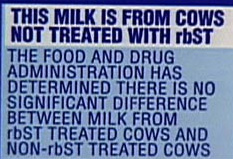
example of rBST-free labeling
Numerous scientific studies have concluded that there is no difference in safety or nutrition between the milk and meat from cows that receive supplemental rBST and those that don’t. Despite this fact, many consumers have voiced their preference for milk from cows that have not received rBST supplements. As a result, several dairy processing companies have worked with cooperatives and individual dairies to secure an “rBST-free” milk supply. Many of these companies then include information on their milk jug labels or dairy food packaging identifying the product as rBST-free or containing "no artificial growth hormones".

The next time you’re standing at the dairy case in your local grocery store, please remember that ALL the milk you see before you is safe and nutritious.  Ultimately, the best dairy milk for you is whichever variety you enjoy the most, so make sure you’re including three servings of dairy products every day as part of your healthy diet!

Sunday, October 16, 2011

Make a difference on World Food Day

Cows have been milked on my family's dairy farm every day for over 55 years. That's over 20,000 consecutive days.  We've been milking cows not just every day of my life, but of my father's as well.  Over half a century worth of Christmases, Thanksgivings, Easters, Independence Days...we've milked cows. And thanks to a generator, we've milked through power outages caused by hurricanes, tornadoes, and ice storms.  In other words, we've been a reliable food provider for a long, long time.  What my grandfather started with just a few cows has grown into what Gilmer Dairy Farm is today: a modern, family owned and operated food production company.  Our seven day a week mission isn't as simple as "making milk", though. We strive to produce a high-quality, nutrient rich food products (milk and beef) that our friends and neighbors will want to include as part of their healthy diets. 

There used to be dozens of small dairy farms dotted across Lamar County, but we're the only one still in operation. Our cows currently produce enough for all of our county's 14,000+ residents to enjoy a daily glass of milk, or enough to meet the "3-Every-Day" recommended servings for just over one-third of our local population. There is more than enough milk produced on other farms throughout our state and nation to serve the other 2/3s of Lamar Countians. In fact, our nation's farmers produce enough nutritious food to feed all Americans, and modern transportation and distribution systems "fill in the gaps" where the local demand exceeds the local supply.

We have an abundant, affordable food supply, yet hunger is a persistent problem. And it's a problem here in Lamar County. With unemployment over 10% and 18% of our residents living below the poverty level, many of our local families are forced to decide between paying rent or putting nutritionally balanced meals on their table. While the situation is bleak, it is far from hopeless. Why? Because we can help.

Today is World Food Day, and I want to challenge all Lamar Countians to do something to help combat our local hunger problem. Designate a few extra dollars in the offering plate this morning for your church's alter fund or food pantry. Donate canned goods to a church or other local food pantry, or volunteer your time to help distribute food to the needy. The West Alabama Food Bank's website lists a few other ways you can help, so I encourage you to check it out.

Together, we CAN make a difference in the lives of our hungry neighbors!

Monday, May 24, 2010

Gilmer Dairy Farm in the FNS Newsletter

Every month, a Food, Nutrition, & Science Newsletter is published by The Lempert Report. One of their monthly features is a Q&A with a farmer, which I was fortunate enough to be the subject of last month.

This month they have added a video feature in which a farmer walks the audience through a typical day on his or her farm. And, you guessed it, I'm the lucky guy this month.

I hope you'll check out my Q&A and video, and I encourage you to subscribe to the newsletter so you can learn about new farmers every month!

Friday, March 5, 2010

Gettin' busy...finally!

We're starting to get a little bit busier on the farm now that Winter finally seems to be ending and Spring looks to be right around the corner.

This week we had fertilizer spread over 125 acres of spring forage (oats, wheat, & ryegrass) and hopefully will see some growth over the next couple of weeks. We've submitted soil samples for several other fields so we'll know what the nutrient and liming needs for our summer crops will be. We'll probably plant about 75 acres of corn in late March or early April, and an additional 45-50 acres in our bottomland IF it has dried out enough by early May. Otherwise, we will plant sorghum-sudangrass (sudex) in the bottomland along with the rest of our cropland in June.

On the cow front, we're currently milking 219 and they are averaging about 63 pounds of milk production per day. Our nutritionist has formulated a new ration for us based off the nutritional analysis of our sorghum silage. We'll begin feeding the new ration over the weekend and hope that we'll see a 2-3 pound per cow increase in milk after a week's time.

Amidst everything else that's happening on the farm, we're also breeding a group of 33 heifers. You can learn more about that project in our newest GDF MooTube Minute:

Wednesday, February 10, 2010

Silage, mud, and TV

Last week we finally began feeding our milking herd the sorghum silage we harvested last fall. It looks pretty good and the cows seem to be enjoying it, but we haven't gotten a forage analysis run on it yet. We'll be calling our nutritionist to take care of that in the next few days so he can adjust the composition of our dairy feed to balance out with the silage. We've used up all the sorghum-sudangrass baleage that we had been grinding in their feed ration, so we're now down to the silage and dry bermudagrass hay as the only forage available to them. Unfortunately for us, we're using our hay (for milk cows and heifers) at such a rate that we'll run out of it before our spring forages and pastures begin putting out enough growth to sustain grazing. So our options will be to either truck in alfalfa from the Midwest or find a more local source of quality bermudagrass hay. The latter is more than likely what we'll do, but either way it'll be an added cost to what already is an expensive feed recipe.

One thing it looks like we won't run out of is mud. Our ground has been incredibly wet ever since September and all the rain we've had is really taking a toll on our pastures. A lack of sunshine has also slowed the growth of our cool-season grasses as well. We had hoped to be intensively grazing our milking herd by mid-March, but the weather is really going to have to change quickly for that to be possible.

Before I sign off, I would like to quickly address a couple of news stories you may have seen on network television lately. ABC's Nightline program recently aired a segment calling the ethics of dairy management practices into question, and the CBS Evening News is currently running a two-part series about the use of anitbiotics in livestock. As a farmer, I get pretty frustrated watching stories like this because I know they don't accurately portray what most of us are really doing on our farms. At the same time, I expect the general public to have lots of questions about food production after watching these stories. This really underscores the need for myself and other farmers to proactively engage with our customers about our on-the-farm practices, and I hope they'll be willing to give us a chance to address any concerns they may have before they form their opinion strictly on what they've seen on TV.

Well, my breakfast break is over and it's time to get to work. I hope you all have a "dairy" good day!

Friday, January 1, 2010

New Year, New Challenges, New Opportunities

Close the book on 2009 and say hello to 2010!

If you ever took notice of the dairy industry this past year, I'm sure you know that it has been quite a rough one for farmers. Really rough! Read some of my blog entries from 2009 and you'll begin to understand what I mean. But, that year is gone and 2010 is sure to present us with both challenges and opportunities.

For dairy farmers, we're still left with the question of how to end...or at least manage...the price volatility cycles that seem to get more extreme and severe every few years. Many different plans for doing so were discussed over the past year and continue to be debated among dairy farmers. None of these plans are perfect or will satisfy every dairyman, but we're smart enough to realize that a "perfect plan" is unrealistic given the vast regional differences in our production and markets. As our milk price continues to improve as it has for the last couple of months, it will be critical that our dairy farmer leaders keep working towards crafting an acceptable plan so we can minimize the next inevitable downturn.

Focusing more on our farm, we also face some early challenges to begin the year. A wet fall meant a short harvest, which means we've had to buy more commercial feed and may also have to buy forages from other farmers by the time our own spring forages are ready to harvest. Buying feed and forages is expensive, and coming off a year like 2009 it really handicaps you from being able to attend to other projects. There will be other challenges as well, ranging from the weather to the costly impact potential legislation and regulations would have on our farm and every farm.

But with challenge comes opportunity, and that gives us hope for a better year even if our recovery process may seem slow and painful at times. From experimenting with rotational grazing to planting new varieties of silage crops, from more effectively telling our farm's story to to laying the groundwork for possibly one day processing and marketing our own milk and dairy products, the future is bright for Gilmer Dairy Farm. My family's been milking cows in Lamar County, Alabama, for over 55 years, and with hard work and a little luck that streak won't be coming to an end anytime soon!

Have a Happy New Year, everyone! I'll leave you with our final GDF MooTube Minute of 2009 which takes a quick look back at that year and also thanks you for allowing us to share our story with you.

Saturday, December 26, 2009

Working on Christmas

I hope you all have had a Merry Christmas and that you are enjoying any time off work that you might have. I know that many businesses close for several days before and after Christmas, but a dairy farm is one business that doesn't have that luxury. Whether it's Christmas, Easter, Independence Day, or any holiday, the cows have to be milked, fed, and attended to.

My father has worked every Christmas day as far back as I can remember, and I've been right there as well since I was about 15. It can keep you from traveling to the in-laws if they have their gatherings on Christmas instead of before (like mine) or after, but all the Gilmer family gatherings happen here on the farm. It's really not that bad of a deal, either. We typically work a "weekend" schedule on holidays and take care of chores before breakfast and then again after lunch. Our milkhand usually likes to work the early shift on holidays, and did so again yesterday. Dad and I were also joined by another employee yesterday afternoon who decided he needed a few hours away from his in-laws.


So whether you're enjoying a holiday feast or just snacking any other day of the year, savor it happily and know that a farmer's commitment to care for his animals and to provide you with quality food never takes a day off!

And in closing, here is a new episode of our MooTube Minute in which I give you a quick tour of our "milk room". Enjoy!


Friday, February 20, 2009

Ask a farmer

All across this nation, America's farmers are working hard to ensure that our citizens have the safest, most affordable, most readily available food supply in the world. Unfortunately, our methods of production come under attack from various special interest groups who claim that the ends don't justify the means. This puts the vast majority of Americans somewhere in the middle, listening to two very different stories from people with two very different viewpoints.

There's a seemingly unending list of websites and blogs you could visit to read thoughts, commentary, and "facts" about why modern agriculture is bad for you, bad for our society, and bad for our planet. While I'm sure that some (but definitely not all) of the folks behind these ideas are good, well-intentioned people, they simply don't have the same real-world viewpoint that someone with dirt under their fingernails and manure on their boots has about these issues.

Auto mechanics aren't asked to mastermind military strategy...generals are. Lawyers aren't qualified to perform heart surgery...doctors are. Celebrities aren't experts on modern food production...farmers are.

At some point in the coming months and years, you will likely be asked to sign a petition, cast a vote, or in some way make a decision that will have an effect on the way America's farmers produce your food. Please take the time to get a farmer's perspective before making your choice. If you're willing to listen and consider our side of the story, I'm pretty confident you'll agree that we're taking good care of you while also being good stewards of the resources entrusted to us.