
This is the second blog post in a three-part series attempting to answer a few frequently asked questions about milk. Yesterday
I explained where people could buy our farm’s milk, and tomorrow I’ll touch on
the differences between “conventional” and “organic” milk. As for today, I hope
I can provide a good answer for all of you that have ever asked or wondered, “Are
there hormones in my milk?”
Cows, like all living creatures that I’m aware of, naturally
produce hormones in their bodies. Some of these hormones are found at very low
(and very safe) levels in cows’ milk. Therefore, any dairy product you buy… whole
milk, skim milk, “organic” milk, cheese, yogurt, etc…will contain traces of
these naturally-occurring hormones. Perhaps where the issue has gotten
confusing is in the use of supplemental rBST and the labeling of rBST-free
milk.
Bovine Somatotropin is a protein hormone naturally produced
in the pituitary gland of all dairy cattle. Supplemental levels of the hormone’s
recombinant form (rBST) can be given to cows during certain times of their
lactation to increase milk production. Essentially, the supplement helps a cow
convert feed into milk more efficiently. The advantage to using rBST is that it
can help a dairy produce more milk without adding more cows to the herd or growing/buying
additional feed. The level of success of the supplement often depends on other
factors such as feed quality and environment. We used rBST for a short time in
our milking herd but did not see enough of a milk increase to warrant its
continued use. Due to that economic
decision, our herd has been “rBST-free” now for well over 10 years.
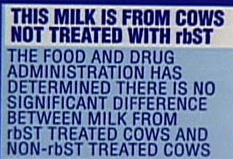 |
| example of rBST-free labeling |
Numerous scientific studies have concluded that there is no
difference in safety or nutrition between the milk and meat from cows that
receive supplemental rBST and those that don’t. Despite this fact, many
consumers have voiced their preference for milk from cows that have not
received rBST supplements. As a result, several dairy processing companies have
worked with cooperatives and individual dairies to secure an “rBST-free” milk
supply. Many of these companies then include information on their milk
jug labels or dairy food packaging identifying the product as rBST-free or containing "no artificial growth hormones".
The next time you’re standing at the dairy case in your
local grocery store, please remember that ALL the milk you see before you is
safe and nutritious. Ultimately, the
best dairy milk for you is whichever variety you enjoy the most, so make sure you’re
including three servings of dairy products every day as part of your healthy
diet!
