Wednesday, June 8, 2011

Weed Zappin'

If this hot, dry weather has been good for anything, it's at least given me an opportunity to kill some weeds this week. This sounds easy enough, but it's not as simple as dumping some chemicals into a tank and taking off across a field. Each herbicide has detailed "do's and don'ts" that we must adhere to. Different rates/concentrations will have different effects in different conditions. Protective clothing must be worn when handling these herbicides, and they often have to be mixed in a certain order when used with liquid fertilizer, adjuvants, or other herbicides in the same tank mix. We use GPS assistance to minimize application skips and overlaps in the field, and keep records that include the time, temperature, and wind speed/direction while making applications.

My first herbicide applications this week were in a large 60+ acre heifer pasture. I used a selective herbicide, primarily targeting pigweed, ragweed, and dog fennel. The weeds showed signs of stress within an hour of being sprayed, and 24 hours later it was obvious they were wilting. Using a selective herbicide to kill weeds removes the competition for soil nutrients, thereby improving the quantity and nutritional quality of the pasture grass (bermuda in this case). Once I finished applying this particular herbicide, I thoroughly cleaned the tanks and sprayer lines as per the instructions on the the herbicide's label.

Today I applied a different selective herbicide on our silage corn crop down in the bottomland. This time it was in an effort to kill and control broadleaf signalgrass, cocklebur, and morning glory. Though it's hard to tell from the photo, quite a few broadleaf weeds have already popped up between the rows. The herbicide I applied should kill them and have enough residual effect to prevent more from sprouting. There are pockets of johnsongrass here and there that this herbicide won't effect, but I can control that with glyphosate in a couple of weeks since the corn is a Roundup-Ready variety.

Speaking of glyphosate, that's likely the next herbicide application on the agenda. We'll either use a minimal- or no-tilling planting technique for our sorghum crop, but first we need to kill all the grasses and weeds that have grown up in the fields. We can't begin the planting sorghum, though, until we get some rain to improve the soil moisture. With that in mind, I probably won't be in any big hurry to get the sprayer back into the field until a couple of days prior to a favorable rain forecast.

Friday, June 3, 2011

Friday farm tidbits

Happy Friday and happy June Dairy Month everyone!  Here are a few tidbits about what's been happening on and around Gilmer Dairy Farm:

It's HOT, Man! - The weather around here has been brutal this week as we've seen record-breaking temperatures push into the upper 90s with afternoon heat indexes well over 100.  We're running 8-10 degrees warmer than normal for this time of year, and trust me when I say you can definitely feel the difference.  The cows are feeling it too, despite our best efforts to keep them as cool as possible with fans & sprinklers. More on this in a moment.

the official drought is still to our south
It's DRY, too! - We aren't officially under drought conditions according to the latest US Drought Monitor, but we are eight days past our last rain and have only received a total of 0.4" over the past three weeks.  The soil moisture in our bottom land is still good enough to get our corn growing thanks to a wet winter and spring, but our fertilized hayfields and pastures are basically doing nothing.  We also can't begin planting our forage sorghum crop until we get enough rain to soften the soil.  If there is a bright spot in the dry weather, it is that it's better for the cows. Why? Throw in lots of moisture with this kind of heat, and cows will wallow-out mud holes in the pasture and run a higher risk of mammary infections.

the milk decline is udderly depressing
Milk production is FALLING! - The cows seem to be producing less and less milk every day. The heat is a major factor, but there are a couple of other factors as well. We're entering the summer with the youngest herd (based on avg. lactation number) we've had in 5 years, so our overall potential production isn't quite as high as it would be with older cows. Also, we have the highest average days-in-milk and days-pregnant we've had in 60 months. This means that an average cow in our herd has been milking for over seven months, is 5 months pregnant, and her milk production would naturally be in decline. The heat stress and related loss of feed intake (like most of us, cows don't eat as much when they're hot) speeds up that decline.  Our milking herd currently stands at 186 cows and will continue to shrink to 165-170 until we begin "freshening" more cows than we dry off sometime mid-Summer.

Nutrient & Pest Management - The dry weather has given an opportunity to spread fertilizer on hayfields and kill weeds in a few pastures earlier this week. The last couple of days we've been working on building a 3-point hitch mount for our 30-foot sprayer boom. If all goes well it will be field-ready by the end of the day, and I'll spend much of next week applying a post-emerge rate of Atrazine in our corn fields and glyphosate in our sorghum fields.

me & my boy
Tee-Ball & Graduation - In the "farm family" category, there are a few things that are coming to an end.  School is now out for the summer, so my wife will enjoy being able to stay home for a couple of months. On a side note, I hope this also means that I get a better quality lunch everyday for the next couple of months!  Secondly, our twice-weekly trips to the ball field will be on hold until next spring now that our 5 year old's tee-ball season is over. I had a lot of fun helping coach his team, and it was gratifying to see how much he and his friends improved over the past couple of months. Best of all (and most importantly at their age), the kids seemed to have fun from start to finish. And finally, our son will "graduate" from pre-school tonight, which just happens to be the 11th anniversary of mine & my wife's first date. I'll tell you what, time sure does fly when you're having fun!

I hope you all have a great weekend, and that the weather is agreeable to you wherever you are. Don't forget to celebrate June Dairy Month by enjoying lots and lots of nutritious, delicious dairy products!  And remember...there's only one more week to enter our farm's Milk Mustache Contest.  We've had some great winning photos in the past, and expect the same this year.  If your kid loves milk and you think he or she has what it takes to be our Milk Mustache "poster child" for the next year, hurry up and grab your camera, pour one more cold glass of milk, and get some photos coming my way!


Tuesday, May 31, 2011

Spreading fertilizer and waiting for rain

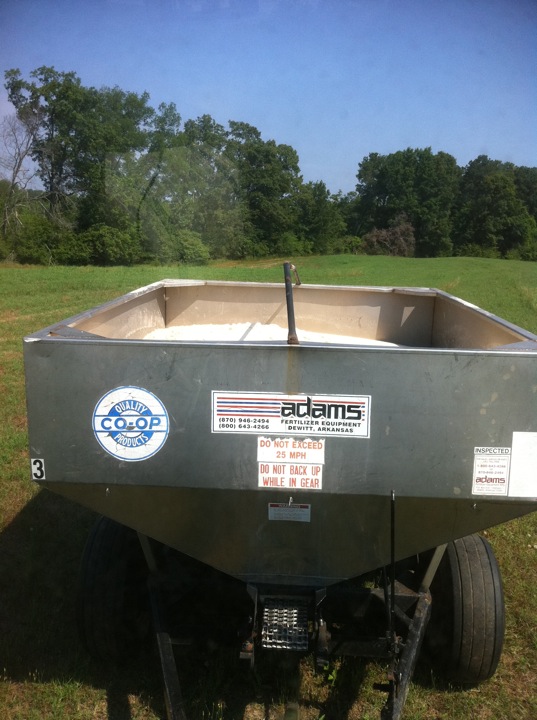
The local co-op delivered a fertilizer buggy full of ammonia nitrate to our farm this morning, along with 900 pounds of 0-20-20 in bags. I spent most of the morning pulling the buggy across hayfields (still 3 more acres to go) while one of our employees spread a mix of the bulk and bagged fertilizer on a few acres of our bottomland that was too wet for the spreader truck to cross last week.

We aren't really hurting for moisture down in the bottomland.  The corn we planted last Wednesday has already emerged, and it looks as if we'll have a good stand down there.  The land around our dairy is a different story though.  Our hayfields are green, but the bermudagrass isn't growing as quickly as it needs to due to a lack of water.  The current forecast calls for a slight chance of thunderstorms Saturday through Monday, so hopefully three days of 30% equal a 90% chance we'll get at least one shower.

Regardless of if we use a no-till or minimal-till method to plant our forage sorghum, that job is also on hold until we get some rainfall.  Our target date for planting had been mid-June, and that's still a possibility if we get any substantial rain within the next 10 days.  We do have a fairly forgiving planting window on the sorghum, though, as we've planted it successfully as late as early July.

So until it rains, we'll tinker around in the shop, maybe spray a few pastures, and keep the cows as cool and comfortable as we possibly can as the heat creeps towards 100 degrees later this week.